


A wholesale customer asks for a 15% discount, and the only way to give it to them is to clone the product, hand-build a second price, and hope nobody on the regular storefront finds the link. That’s not a hypothetical. It’s what happens by default on most WordPress stores the day a single customer needs a price nobody else gets.
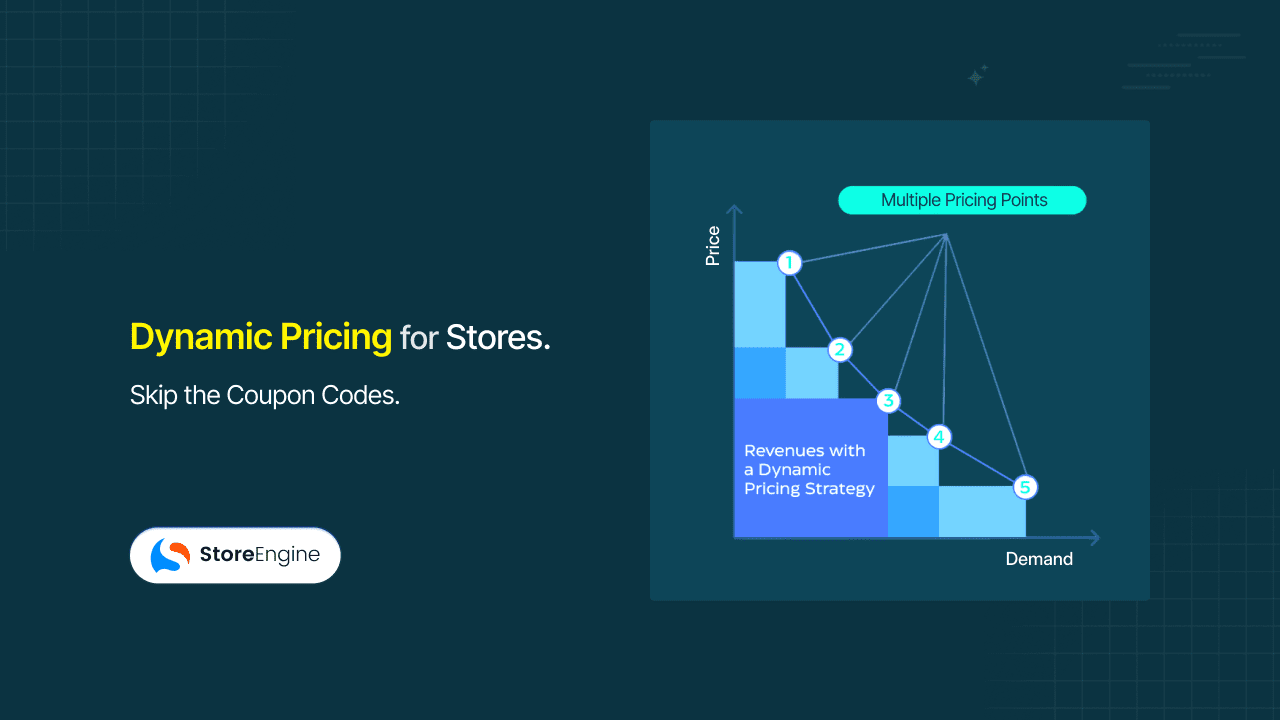
Dynamic pricing fixes this by letting a store set rules instead of duplicate products or one-off coupon codes — the price adjusts itself based on who’s buying, how much they’re buying, and when. Most advice on dynamic pricing assumes you’re Uber or an airline running a data science team. That’s backwards for a small or mid-size WordPress store, where the real need is simpler: give the right person the right price, automatically, without a developer and without three plugins fighting each other at checkout.
By the end of this guide, you’ll know exactly how StoreEngine’s dynamic pricing rule engine handles this with no-code rules built directly into checkout, and how to decide if it’s the right fit for your store.
Quick Answer: What Is Dynamic Pricing?
- Dynamic pricing means changing a product’s price automatically based on conditions like quantity, customer role, or date, instead of charging one fixed price to everyone.
- StoreEngine’s Dynamic Pricing is a no-code rule engine built natively into its WordPress ecommerce plugin, so rules apply without installing a separate add-on.
- Stores use it to give wholesale buyers a different rate, reward bulk orders, run a sale that starts and ends on its own, or apply separate logic to subscription renewals.
- Unlike a coupon code, dynamic pricing applies without the customer needing to know or type anything — the discount or fee just shows up.
- Most WordPress ecommerce setups only get this through a separate paid add-on plugin, since rule-based pricing isn’t part of the standard checkout out of the box.
What Is Dynamic Pricing? (Definition + Example)
Dynamic pricing is a pricing strategy where a product or service’s price changes based on real conditions — demand, timing, quantity, or who’s buying — instead of staying fixed for every customer. The classic example is an Uber fare that climbs when ten people in the same neighborhood are all requesting a ride at once.
For a WordPress store, the more useful example looks different. WooCommerce remains the default choice for a lot of people starting a WordPress store, powering more than 4.5 million live sites and roughly a third of the global ecommerce market by store count (Red Stag Fulfillment, 2026). What that default setup doesn’t include is a native way to handle a wholesale buyer who deserves 10% off, a customer who just ordered 50 units and should get a quantity break, or a Black Friday sale that someone has to remember to turn off on Monday morning.
That’s dynamic pricing at small-business scale: not algorithmic surge pricing, but a set of conditions — quantity, role, date, order history — that quietly decide the final price. Once you see it this way, the next question is obvious: how do most stores actually handle this today, and why does it break down so fast?
The Manual Workaround Problem

The manual workaround problem is what happens when a store has no native way to apply different prices to different situations, so it improvises with tools that weren’t built for the job. Editing the base price changes it for every shopper. A coupon code only works if the customer knows it exists and remembers to type it in. And on most WordPress setups, getting real rule-based pricing means stacking on yet another plugin on top of whatever’s already running.
I’ve seen this fail when a store tries to run wholesale pricing through a separate, “hidden” product instead of a rule. The moment that product gets indexed by Google or shared in a group chat, the secret price stops being secret. The common advice to “just use a coupon code for VIP customers” is wrong for any store with repeat wholesale buyers — codes get shared, forgotten, or quietly expire while nobody notices the lost revenue.
The data backs up how widespread this frustration is. The average online cart abandonment rate sits at roughly 70% across more than 50 studies, and extra costs or pricing friction are consistently among the top reasons shoppers cite (Baymard Institute). On the B2B side, it’s worse: 64% of B2B buyers say accurate, customer-specific pricing matters when ordering online, and 33% are actively frustrated when a site shows them a static price that ignores their negotiated rate (Sana Commerce).
So the pattern is consistent. Manual price edits, duplicate products, and coupon codes are all workarounds for one missing piece: a way to define a rule once and let it apply itself, natively, without bolting on another plugin. That’s the real test when comparing dynamic pricing WordPress plugin options — not whether a plugin can technically apply a discount, but whether the rule logic lives natively in the platform or gets stitched on top of it after the fact.
How StoreEngine’s Dynamic Pricing Engine Actually Works

StoreEngine’s Dynamic Pricing engine works by running every cart and product through a five-part pipeline: a rule, a context, an evaluator, an engine, and a set of hooks that apply the result. An admin builds a rule — name it, pick a target, set the adjustment — and the system handles everything after that without manual intervention.
It helps to compare this to how the rest of the industry talks about implementation. Vendavo’s pricing glossary outlines a six-step process for setting up dynamic pricing — define objectives, analyze segments, choose a model, set guardrails, automate, and monitor (Vendavo). That’s sound advice for an enterprise pricing team with engineers on staff. StoreEngine compresses those six steps into one visual rule builder: you set the conditions once, and the Context step at runtime pulls in the real values — the cart, the product at quantity one, or a subscription renewal order — and checks them against what you defined.
Here’s a concrete walkthrough. Say a rule targets the “Shoes” category, requires a quantity of five or more, and applies a 15% discount. A customer adds six pairs to their cart. The Context resolves the cart’s actual contents. The Evaluator checks: is the category Shoes? Yes. Is quantity ≥ 5? Yes. The Engine calculates the 15% adjustment, and a Hook applies it directly to the line-item price — no coupon field, no separate plugin, no manual review.
Every rule is also exposed through a full REST CRUD API with a schema endpoint, so a development team can manage pricing rules programmatically, sync them with an external system, or build a custom admin view. Server-side validation rejects malformed condition trees before they ever reach checkout, so a broken rule can’t silently apply the wrong price.
That mechanical core is what separates a real rule engine from a spreadsheet of manual exceptions. The next question most store owners ask is what they can actually build with rules like this in practice.
No-Code Rules: Quantity Tiers, Role-Based & Customer-Specific Pricing

No-code rules work by letting a store owner combine conditions — quantity, customer role, spend history, product, SKU — into AND/OR groups without writing a line of code. A rule like “(quantity ≥ 5 AND category = Shoes) OR (role = wholesale)” reads almost like plain English, and that’s the point.
This is where customer-specific pricing, quantity-based pricing, and role-based pricing stop being separate problems and become one system. A wholesale customer gets their role-based rate automatically at checkout. A retail shopper buying in bulk gets a quantity discount on the same product, through a different rule, with no overlap or manual tracking required.
Sana Commerce’s research found that 69% of B2B buyers expect their negotiated or dynamic pricing to just show up online, without asking for it (Sana Commerce). In practice, the teams that get this right build the rule once, attach it to a user role like “wholesale,” and never touch it again — the price recalculates correctly for every order that role places, forever.
Rules aren’t limited to discounts either. The same engine can add a fee — a small surcharge for cash-on-delivery orders, for example — using the exact same condition logic, just flipped from a negative adjustment to a positive one. And every rule can sit in draft while you build and test it, so nothing goes live on the storefront until you’re ready to publish it.
Conditions can stack beyond just the obvious ones too: line subtotal, total cart item count, order count, total spent, account age. Once those conditions are in place, the natural next move is adding time limits, so a rule doesn’t just target the right customer — it targets the right moment.
Scheduled Sales That Start and End Themselves
Scheduled sales work by attaching a start date and end date directly to a pricing rule, so the discount activates and expires without anyone logging in to flip a switch. Shopify’s research on dynamic pricing models singles out time-based pricing as one of the most common types businesses use (Shopify), and it’s also the easiest one to get wrong manually.
Picture a Black Friday sale. The standard approach is editing every product price down on Thursday night and remembering to edit it back up on Monday. Miss that second step, and the store quietly bleeds margin for a week. A scheduled rule inside StoreEngine removes that risk entirely — the discount window is built into the rule itself, with a priority order if it overlaps with anything else running at the same time.
This same scheduling mechanic supports a launch discount, a flash sale, or a seasonal category-wide markdown, all without anyone needing to remember a manual cleanup step. But scheduling alone still treats every transaction the same way once a customer is inside the rule — and that’s a problem the moment subscriptions enter the picture.
Dynamic Pricing for Subscription Renewals (The Part Every Other Guide Skips)

Dynamic pricing for subscription renewals works by letting a rule apply differently to a subscription’s first payment than to every renewal that follows it. None of the major glossaries from Salesforce, Vendavo, or Shopify mention subscription pricing at all — which is striking, given how common recurring billing has become.
Here’s why that gap matters. A launch discount should usually apply once and disappear. A loyalty discount should usually persist for as long as the customer stays subscribed. Without separate control over “initial only,” “renewals only,” or “all transactions,” a store is stuck choosing one blunt setting that’s wrong for at least one of those two cases.
In practice, the teams that get subscription pricing right separate the first payment from every renewal that follows it — and almost nobody does this by default, because most platforms don’t expose the option. StoreEngine re-applies eligible rules to subscription renewal orders automatically, and the admin chooses up front whether a given rule should touch the first payment, every renewal, or both.
That distinction is arguably the single biggest gap between what most “dynamic pricing” content describes and what a subscription-based store actually needs. It also raises a related question: what happens when more than one rule wants to apply to the same order at the same time?
Stacking & Priority: What Happens When Multiple Rules Apply
Stacking and priority determine what happens when two or more pricing rules match the same cart at once, and every store running more than a handful of rules eventually hits this. Inside StoreEngine, a store can choose between four stacking modes — apply all discounts together, apply only the first match, apply only the largest, or apply only the smallest — and set this independently for line-item rules versus checkout-level rules.
The mistake I see most often is stacking every discount with no priority order, so a 10% loyalty discount and a 20% flash sale quietly combine into a 30% price nobody approved. Vendavo’s pricing glossary warns about a related risk: without clear guardrails, overlapping pricing logic can spiral into a race to the bottom that erodes margin without anyone noticing until the numbers come in (Vendavo).
A practical example: a flash-sale rule and a wholesale-role rule both target the same product during a sale weekend. With “largest” stacking selected, the system applies whichever discount benefits the customer most, but doesn’t add them together. With “all,” it sums them — which might be intentional, or might be a margin leak waiting to happen.
Discounts under any stacking mode are clamped at zero, so a customer can never end up with a negative line item no matter how many rules pile on. That guardrail matters, but it doesn’t replace thinking through priority order before a sale goes live — and it sets up the real comparison every store owner is actually trying to make: the old manual process against a rule engine that handles all of this natively.
The Old Way vs. the Rule-Engine Way

The old way relies on manual price edits, coupon codes, or a bolt-on plugin layered over an existing store, while the rule-engine way relies on a single set of stored conditions that apply themselves at checkout, on the shop page, and on every renewal. I’ve watched store owners install three different plugins just to approximate what one native rule engine does by default — and then spend a weekend untangling which plugin’s discount actually won.
|
Factor |
Manual price edit |
Coupon code |
Bolt-on pricing plugin |
StoreEngine (native) |
|
Targeting |
Everyone sees the new price |
Anyone with the code |
Specific, but layered on top of the store |
Specific, built into the core |
|
Expiration |
Manual — easy to forget |
Manual — easy to forget |
Depends on the plugin |
Built-in start/end date |
|
Setup |
None needed |
Minutes |
Install, configure, test for conflicts |
Native — no extra install |
|
Best for |
Permanent base-price changes |
One-time public promotions |
Stores already committed to one platform |
Wholesale, bulk tiers, renewals, recurring sales |
Sana Commerce’s data on B2B frustration makes the cost of the old way concrete: 33% of buyers are actively annoyed by static pricing that ignores their actual agreement (Sana Commerce). That’s not a hypothetical complaint — it’s a measurable reason buyers look elsewhere.
The table makes the trade-offs obvious on paper, but the real test of any pricing approach is whether the customer trusts what they’re seeing. That’s where transparency comes in.
Why Customers Should See Why Their Price Changed
Customers should see why their price changed because an unexplained price difference reads as unfair, even when the underlying logic is completely legitimate. The FTC’s 2025 lawsuit against Live Nation and Ticketmaster centers on exactly this problem: prices displayed at checkout could run 24% to 44% higher than what was advertised, with no clear explanation for the gap (FTC, 2025).
Walmart has clearly learned from watching that backlash play out. As its digital shelf labels roll out to every U.S. store, the company’s own COO has gone on record saying surge pricing “is not our approach,” emphasizing that prices stay consistent for every customer in every store (Modern Retail). That’s a major retailer actively distancing itself from the perception problem dynamic pricing can create.
StoreEngine builds transparency into the rule itself, not as an afterthought. When a rule applies, the shop page shows a label like “Black Friday” next to the strikethrough price, and the cart shows a line reading “Discount: Black Friday” instead of just a smaller total with no explanation. The same rule name gets saved to the order’s line-item meta, so a support agent can answer “why was I charged this?” in seconds instead of guessing.
That same transparency habit is also the best defense against the legal and ethical questions dynamic pricing tends to raise.
Is Dynamic Pricing Legal? Is It Price Gouging or Discrimination?
Dynamic pricing is legal in most markets, including the U.S. and U.K., as long as it doesn’t cross into deceptive pricing, price gouging during emergencies, or pricing based on protected characteristics. Wikipedia’s overview of the strategy classifies it as a standard revenue management technique, distinct from illegal price discrimination based on a person’s identity (Wikipedia).
Where it gets risky is transparency, not the underlying math. The U.K.’s Competition and Markets Authority opened an investigation into Ticketmaster’s dynamic pricing during the 2024 Oasis reunion ticket sale, specifically because fans weren’t told prices could surge mid-purchase (NPR). That’s a regulator responding to a transparency failure, not to the concept of variable pricing itself.
Is it price discrimination? Not by default. Price discrimination specifically means charging different prices based on a customer’s identity — age, gender, race — which is restricted in most jurisdictions. Charging a wholesale buyer less because they ordered 500 units is a quantity-based business decision, not discrimination, and the two get confused constantly in casual conversation.
Rules built with visible labels — the kind StoreEngine attaches to every applied discount — are the most direct way to stay clearly on the legal and ethical side of that line. With that settled, it’s worth weighing the actual upside and downside of running dynamic pricing at all.
Advantages and Disadvantages of Dynamic Pricing
Dynamic pricing’s biggest advantage is capturing revenue that a single fixed price always leaves on the table, while its biggest disadvantage is the trust it can cost if customers feel the pricing logic is hidden from them. One Salesforce practitioner described rolling out dynamic pricing for an online power-tool retailer and seeing quarterly revenue increase by 9% after tying prices to demand, competitor activity, and seasonality (Salesforce).
Advantages:
- Captures more revenue from customers willing to pay more, without losing price-sensitive customers to a single high price point.
- Moves slow inventory automatically through scheduled markdowns instead of manual clearance decisions.
- Rewards loyalty, bulk orders, and wholesale relationships without separate products or manual invoicing.
- Reduces the support burden of customers asking “why is my price different” when labels explain it upfront.
Disadvantages:
- Can feel unfair to customers who later discover someone else paid less for the same item.
- Requires careful rule design, since stacking errors can quietly erode margin.
- Carries regulatory attention in certain industries — travel, ticketing, and emergency goods — if pricing logic isn’t disclosed.
Most frameworks treat these as competing forces in tension, where capturing revenue and keeping customer trust are a tradeoff. In practice, transparent rule labeling makes that tradeoff far smaller than the glossary articles suggest — which is exactly the gap most existing dynamic pricing content leaves unaddressed.
Who Already Uses Dynamic Pricing
Stores and platforms across nearly every industry already use dynamic pricing, ranging from household names to small WordPress shops applying the same logic at a tiny fraction of the scale. Airbnb’s Smart Pricing tool automatically raises nightly rates during local events, and Amazon adjusts prices algorithmically to compete for the Buy Box against rivals like Walmart (Vendavo).
Amazon Marketplace alone is expected to be part of an online marketplace segment handling 35% of all U.S. retail sales by 2027 (HBS Online, citing eMarketer), and that volume only works because pricing adjusts automatically rather than through manual review of every listing.
Outside the household names, the same logic shows up in self-storage facilities adjusting unit rates by occupancy, parking systems charging more during peak hours, vacation-rental management tools like Hospitable adjusting nightly rates by season, and ticketing platforms running surge pricing during high-demand events. The mechanism is identical in every case — conditions trigger a price change — only the scale and the specific conditions differ.
For a WordPress store owner, the relevant comparison isn’t Uber or Amazon. It’s a smaller shop running the exact same rule logic, just scoped to wholesale tiers and seasonal sales instead of citywide ride demand — which brings up a question worth settling directly: how is this actually different from variable pricing?
Dynamic Pricing vs. Variable Pricing: What’s Actually Different
Dynamic pricing changes prices continuously, sometimes in real time, based on shifting conditions, while variable pricing changes prices on a fixed, predictable schedule that’s decided in advance. Shopify draws this exact line: variable pricing might mean charging more every weekend, while dynamic pricing reacts to live conditions as they happen.
In StoreEngine’s rule engine, both patterns are really the same mechanism with different inputs. A scheduled weekend price bump is variable pricing — predictable, calendar-based. A rule that reacts to a customer’s role or a cart’s quantity in real time is dynamic pricing — condition-based, evaluated fresh on every checkout.
The practical point: you don’t need to pick one or the other. A single rule engine can run both at once — a scheduled seasonal sale (variable) stacked correctly against a live wholesale discount (dynamic) — as long as the stacking and priority settings are configured deliberately.
With the mechanics, the comparisons, and the legal questions all covered, the only thing left is deciding whether this approach actually fits your store.
Is Dynamic Pricing the Right Fit for Your Store?
Choosing between a manual process, a generic dynamic pricing software platform, and a native rule engine comes down to how complex your pricing actually is. Here’s how to tell which approach fits:
- If you sell to wholesale or repeat B2B buyers at a different rate than retail customers → use StoreEngine’s role-based dynamic pricing rules instead of duplicate products, so the discount applies automatically the moment that customer logs in.
- If you run seasonal or flash sales more than once or twice a year → use scheduled rules with start and end dates instead of manual price edits, so nobody has to remember to turn the sale off.
- If your store sells subscriptions and you’ve ever wanted a launch discount that doesn’t carry forever, or a loyalty discount that does → choose a dynamic pricing platform that specifically separates initial-payment rules from renewal rules, since most dynamic pricing software for retailers skips this entirely — StoreEngine is built around this exact distinction.
- If your store runs fewer than five products with one price each and no recurring billing → a rule engine is probably more than you need right now; a single seasonal coupon code will do the job until your pricing logic gets more complex.
FAQ
What is dynamic pricing, with a simple example?
Dynamic pricing is a pricing strategy where the price changes automatically based on conditions like demand, quantity, or customer type. A simple example: a store charges $20 per item normally, but a rule automatically drops the price to $17 per item when a customer orders five or more.
What are the advantages and disadvantages of dynamic pricing?
The main advantage is capturing revenue a single fixed price would miss, by charging different amounts to different segments based on real conditions. The main disadvantage is the trust risk if customers feel the pricing logic is hidden, which is why showing a clear discount label matters as much as the discount itself.
Is dynamic pricing legal, and is it the same as price gouging or price discrimination?
Dynamic pricing is legal in most countries as long as it’s based on business logic like quantity or timing rather than a customer’s protected identity. It becomes a legal problem only when it’s deceptive, as seen in the FTC’s 2025 case against Ticketmaster over undisclosed price increases at checkout.
Do I need coupon codes if I use a dynamic pricing rule engine?
No. A rule engine applies discounts automatically based on conditions you set, so customers never need to know or enter a code. Coupon codes still work alongside rules for public, one-time promotions, but they’re no longer required for wholesale, bulk, or loyalty pricing.
Will my dynamic pricing rules apply to subscription renewals automatically, or do I have to set that up separately?
With StoreEngine, rules apply to renewal orders automatically once you mark them eligible, and you separately choose whether a rule applies to the initial payment only, renewals only, or both. Without that setting, most platforms apply one blunt rule to every transaction, which is wrong for either a launch discount or a loyalty discount.
Does this work with my existing WordPress theme and checkout, or do I need custom development?
StoreEngine’s Dynamic Pricing is native to its own checkout and cart, so it shows strikethrough pricing on the shop page and discount labels in the cart and checkout without theme changes. No custom development and no separate plugin install is required to set up or run rules through the visual builder.
Can I see which discount rule was applied to a specific order after the fact?
Yes. Every rule that applies to an order gets saved to that order’s line-item meta, so you can open any past order and see exactly which rule produced the final price. This also shows up in customer-facing receipts as a named discount line, not just a smaller total with no explanation.