


Every serious online store owner has lived the same nightmare: one plugin for checkout, another for subscriptions, a third for shipping, a fourth for reviews, a fifth for coupons — each with its own settings, its own update cycle, and its own way of quietly breaking the other four. You don’t run a store. You run a plugin support desk.
StoreEngine was built to end that. Not with “yet another feature,” but with a single, deliberate promise: one reliable, all-in-one eCommerce platform where everything just works together.
That promise was never going to be a single release. It was a plan — a big one — and today, with StoreEngine 2.2.0, that plan is complete. Here’s the story of how we got here.
Before 2.0.0: We Drew the Whole Map First
Most plugins grow by accident. A feature here, a request there, and three years later you have a tangle nobody can explain. We took the opposite approach. Before writing a line of 2.0.0, we mapped the entire picture of what a complete, dependable eCommerce solution actually needs — from the first product upload to checkout, subscriptions, fulfilment, shipping, tax compliance, fraud protection, and everything in between.
Then we split that map into three deliberate releases:
Three steps. One destination. Let’s walk through them.
The Foundation
Released in June 2026, 2.0.0 was where the plan became real. This wasn’t a point update — it was the groundwork the entire platform would stand on.
Selling the way modern stores actually sell. Native Stripe subscriptions with webhook-driven renewals landed here, and — crucially — subscriptions could now sit in the same cart as one-time products and be bought instantly, with a “Pay Next Renewal Now” option for early renewals.
Compliance, built in — not bolted on. A new SEO addon bridged into Yoast, Rank Math, AIOSEO and SEOPress (or ran standalone, serving SEO data over REST for headless storefronts). New GDPR, EU Compliance and EU VAT addons wired straight into WordPress’s Privacy API, handling VAT validation, sequential invoices and consent logs — replacing a shelf of third-party plugins on their own.
AI from day one. A native AI addon built on WordPress 7.0’s AI generation produced product copy, SEO meta and bulk content — no API keys required.
Operational muscle. SKU and barcode generators, free barcode labels, an admin refund UI, customer-facing license management, a dummy-data Seeder with a wp storeengine seed CLI command, full WP-CLI support, brand organization, and multi-vendor fulfilment with courier and tracking.
2.0.0 didn’t try to be finished. It tried to be right — a foundation strong enough to carry everything still to come.
The Stable Release
A foundation is only worth as much as its reliability. 2.1.0 (and the fast-following 2.1.1) was the release where we stopped adding weight and started proving the platform could be trusted with real revenue.
New capabilities, yes — a full Funnel Builder with step pages and an aBlocks canvas, a brand-new email/content builder replacing Quill, Stripe Automatic Tax, an Instant Checkout contact + OTP block with phone verification, and AI-powered product-description and taxonomy generation.
But the real story was hardening. 2.1.0 shipped a full WordPress Plugin Check remediation — the distributed build reports zero errors, with proper output escaping, prepared statements, direct-access guards and complete internationalization. On the Pro side, we closed multi-vendor privilege-escalation holes (a self-registered vendor could previously approve and pay themselves) and fixed a path-traversal issue in digital downloads.
Then 2.1.1 chased down the real-world edge cases that only surface at scale: Stripe Elements failing to load on checkout, coupon fatals during cart initialisation, stale back/forward-cache pages, membership bugs, and untranslatable admin strings.
This is what “stable” actually means. Not “no new features” — but every feature you depend on, behaving predictably, on real stores, under real load.
The Vision, Completed
A storefront that converts like the big brands
Fulfilment and supply chain, end-to-end
Platform maturity
And it finally looks like one product
Perhaps the most visible change: a major admin UI refresh onto a single shared Tailwind design kit. Settings, the product editor, the setup wizard, checkout and the dashboard — all rebuilt on one system with consistent cards, themed controls and a reorganized, collapsible navigation. On the Pro side, Dropshipping, Returns, Fraud Shield and Deployment Analytics all moved onto the same kit. It doesn’t just do everything anymore. It finally feels like one thing.
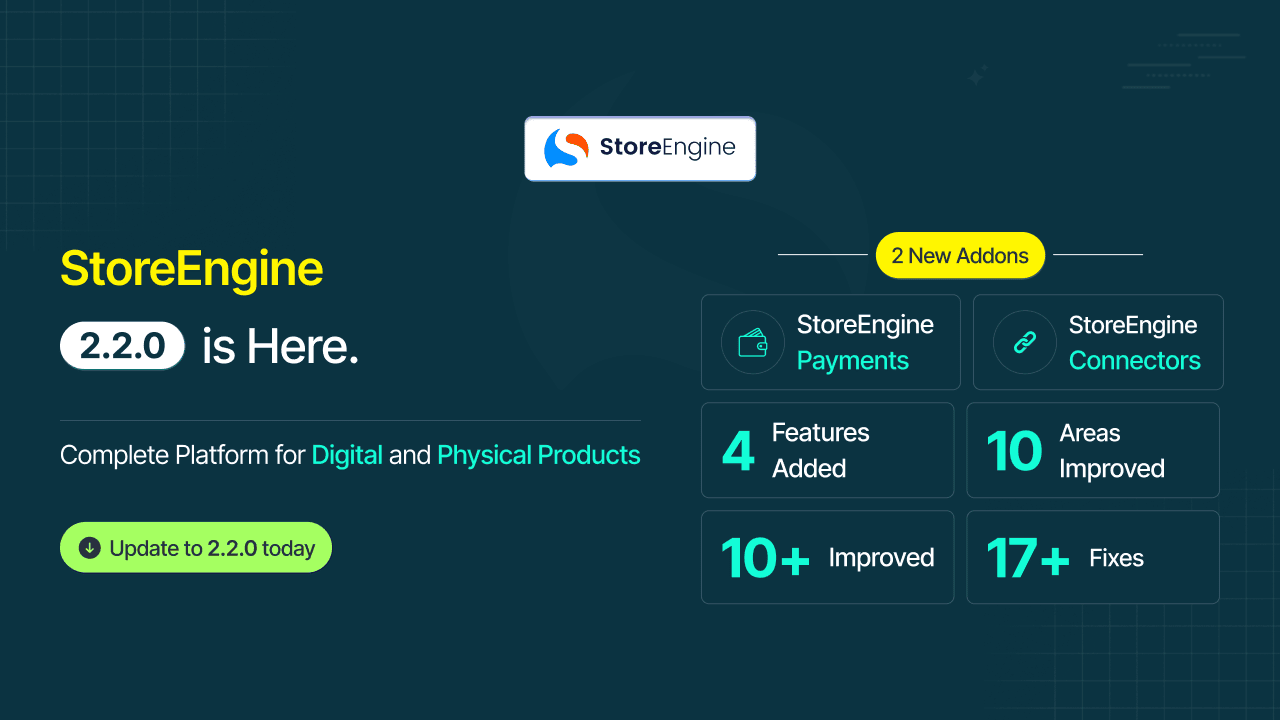
We said StoreEngine would become a reliable, all-in-one eCommerce solution. With 2.2.0, the missing pieces are gone — now anything is possible inside StoreEngine.
What “All-in-One and Reliable” Actually Means Now
Selling
Simple, variable and digital products, bundles, subscriptions, and instant checkout.
Conversion
Quick view, wishlist, compare, reviews, FAQs, size charts, funnels, order bumps, dynamic pricing, advanced coupons.
Fulfilment
Couriers, dropshipping, suppliers, purchase orders, returns/RMA, and POS.
Growth
SEO, AI content, multi-vendor marketplaces, affiliates, and abandoned-cart recovery.
Compliance & Trust
GDPR, EU VAT, Fraud Shield, OTP verification, and staff permissions.
Operations
Inventory, cost & profit tracking, analytics, backups, webhooks, WP-CLI, and headless REST.
That’s not a plugin. That’s a platform — and it all shares one dashboard, one design system, one update cycle, and one team standing behind it. The plan we drew before 2.0.0 is now on the screen in front of you.
The Bottom Line
We said StoreEngine would become a reliable, all-in-one eCommerce solution. We meant it as a roadmap, not a slogan — and we shipped it in three honest steps: a foundation in 2.0.0, stability in 2.1.0, and completion in 2.2.0.
With 2.2.0, the missing pieces are gone. Whatever your store needs to do — sell it, ship it, comply with it, protect it, analyze it — it’s now possible inside StoreEngine.
Update to StoreEngine 2.2.0 today
Run your entire store from one place that actually works together — no add-on sprawl, no plugin conflicts, no compromises.
Frequently asked questions
Do I need to buy Pro to get the all-in-one experience?
No. The vast majority of what makes StoreEngine “all-in-one” ships in the free core — subscriptions, SEO, GDPR/EU VAT compliance, couriers, wishlist, quick view, reviews, FAQs, funnels, and more. Pro adds power-user layers like Dropshipping settings, Fraud Shield, Role & Staff Permissions, advanced coupons, dynamic pricing, and installment plans.
I’m on 2.1.x — is upgrading to 2.2.0 safe?
Yes. 2.2.0 builds directly on the hardened 2.1.x base and introduces no table drops (StoreEngine never drops tables). As always, back up before any major update — and 2.2.0 even adds scheduled backups to make that easier.
If I use StoreEngine Pro, do I upgrade both plugins together?
Yes — update free core to 2.2.0 and Pro to 2.2.0. Pro has a built-in compatibility gate that keeps your site safe if the versions ever get out of sync, showing a notice instead of crashing.
What happened to the courier/shipping features — did they move?
The courier framework moved into free core in 2.2.0 (it was previously Pro). The actual carriers ship in the free StoreEngine Connectors companion plugin, which core can install for you in one click.
Do I still need separate plugins for SEO, reviews, or compliance?
No. SEO (with Yoast/Rank Math/AIOSEO/SEOPress bridging), product reviews with photo/video, FAQs, GDPR, and EU VAT are all built in — one dashboard, one update cycle.
Will the new admin UI redesign change how I work?
The layout is refreshed onto a single design system with a reorganized, collapsible sidebar, but your data and workflows are unchanged — it’s the same StoreEngine, just more consistent and easier to navigate.
Does StoreEngine support headless / API-driven storefronts?
Yes. SEO data and store data are exposed over REST, there’s a /me endpoint for headless auth, incoming webhooks, and full WP-CLI support.
Is StoreEngine 2.2.0 compatible with the latest WordPress?
Yes — it’s tested up to WordPress 7.0 and uses WordPress 7.0’s native AI generation for product copy and SEO meta (no API keys required).