


You already have traffic. Ads, SEO, email, social — something is bringing people to your store. And then most of them leave without buying. That’s not a traffic problem. That’s a conversion problem, and it’s the most expensive one in ecommerce because you’re already paying for the visitors you’re losing.
Ecommerce conversion rate optimization is the practice of turning more of your existing visitors into buyers by removing friction, building trust, and making the path to purchase as short as possible. The math is what makes it so valuable: according to Fullstory’s 2026 ecommerce CRO guide, increasing your conversion rate from 2% to 3% translates to 50% more revenue — from the exact same traffic, at zero additional acquisition cost.
Most CRO guides hand you a list of strategies and leave you to assemble a pile of plugins to actually ship them. This one is different. Every proven lever below maps to a tool built natively into StoreEngine, so the fix lives inside your store engine instead of across five bolted-on systems.
Quick Answer: What Is Ecommerce Conversion Rate Optimization?
What Is Ecommerce Conversion Rate Optimization?
Ecommerce conversion rate optimization is the systematic process of increasing the share of visitors who buy, using data to find where they drop off and removing that specific friction. It’s not redesigning your whole store on a hunch — it’s identifying the exact drop-off point and engineering it away.
The conversion rate formula is simple: divide total orders by unique visitors and multiply by 100. According to Yotpo’s 2026 ecommerce CRO benchmark report, average ecommerce conversion rates hover between 1% and 3% globally, though a healthy benchmark for optimized stores is closer to 2–4%. The more useful goal isn’t chasing a universal number — it’s improving your own baseline over time, because the compounding effect is what creates durable revenue growth.
Here’s the framing most guides skip: CRO isn’t one magic change. It’s a series of specific friction removals, each adding a few percentage points, that stack into a meaningfully higher conversion rate.
Why Checkout Friction Is the Biggest Revenue Leak
The single largest source of lost ecommerce revenue isn’t bad products or weak branding — it’s the checkout. According to Baymard Institute’s meta-analysis of 50 studies, the average cart abandonment rate is 70.22%. That’s roughly 7 of every 10 people who add to cart leaving without buying. Baymard estimates that $260 billion in orders are recoverable in the US and EU through better checkout design alone.
Why shoppers actually abandon
The causes are well-documented and almost entirely fixable. According to Baymard Institute’s checkout abandonment research, among shoppers who intended to buy, unexpected extra costs are the top trigger at 48%, forced account creation causes 26%, security concerns cause 25%, slow delivery causes 23%, and a complex or long checkout process causes 22%. Four of those five have nothing to do with your product — they’re friction and trust problems you can engineer away.
The friction is often literal length. Baymard’s checkout benchmark database shows the average US checkout contains 23.48 form elements — nearly double the 12-14 that Baymard identifies as optimal. And the payoff for fixing it is enormous: the average large ecommerce site can gain a 35.26% increase in conversion rate through better checkout design alone.
How StoreEngine removes checkout friction natively
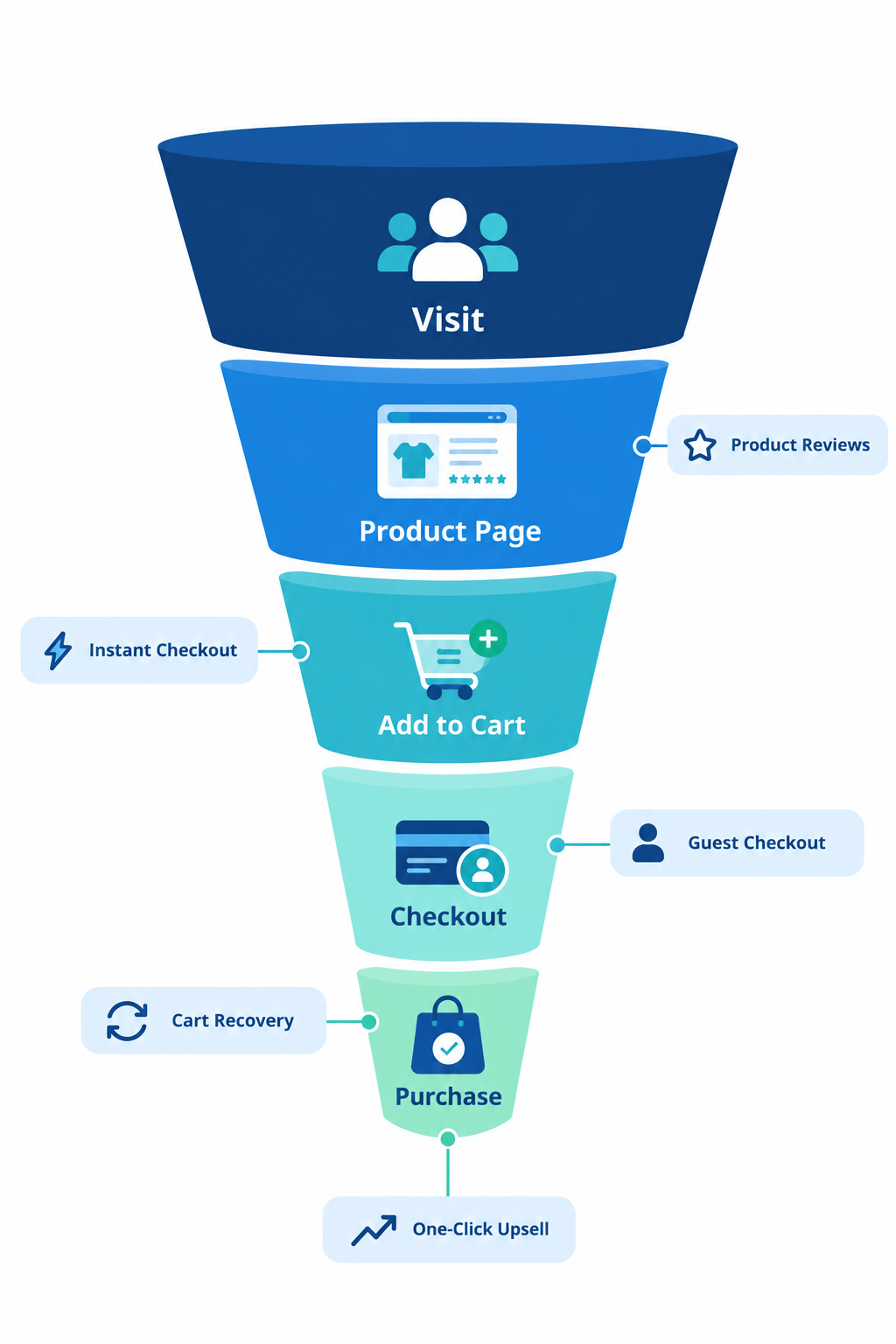
StoreEngine attacks checkout friction with three native tools. Instant Checkout renders a one-page quick-checkout modal that lets a buyer skip the cart entirely and complete the purchase in a single focused step — no multi-page flow. Embeddable Checkout lets you drop that checkout form directly onto any post or page, so shoppers never leave the content that convinced them. And Guest Checkout removes the forced-account-creation barrier that causes a quarter of all abandonments: according to GR4VY’s 2026 checkout optimization guide, guest checkout as the default option reduces abandonment by 20–45% depending on industry and customer base.
What this solves is the gap between “I want this” and “I bought this.” Fewer steps and fields between those two moments means more sales survive. The full breakdown lives in Checkout Optimization for WordPress Stores.
How to Recover the 70% Who Abandon Anyway
Even with a well-optimized checkout, some shoppers will leave. Cart recovery is one of the highest-ROI plays in CRO because these are people who already expressed intent to buy.
A three-email sequence, not a single reminder
StoreEngine’s Abandoned Cart addon captures carts and sends a timed sequence of up to three reminder emails — each with its own configurable delay. The reason this sequence matters: Klaviyo’s benchmark data across 143,000+ flows shows abandoned cart emails average a 50.5% open rate, the highest of any automated email type. One email misses the shoppers who weren’t ready yet; a spaced three-email sequence catches them at different moments without becoming noise.
Recovery discounts and one-click cart restore
You can attach a recovery coupon to the sequence — with a controllable discount type, amount, and expiry — so you only give margin away when it actually closes the sale. And every reminder carries a cart-restore token that lets the shopper return to an identical, pre-filled checkout with a single click. No re-adding items, no re-entering details. In practice, this matters most on mobile, where re-building an abandoned cart from scratch is exactly the kind of friction that kills the second attempt.
Does Sticker Shock Kill Your Higher-Priced Sales?
Yes — and it’s one of the most fixable conversion killers on expensive products. When the full price lands at once, high-ticket shoppers hesitate and leave. According to GR4VY’s checkout abandonment research, offering BNPL at checkout reduces abandonment by around 20% for orders over $100 and by nearly 30% for shoppers aged 18 to 34.
StoreEngine’s Installment Plan lets your store offer its own pay-later terms — a deposit today plus a schedule of payments you define — without renting a third-party provider that charges 3–6% per transaction and credit-checks your customer. The shopper sees a manageable “due today” amount instead of the intimidating full price, which is exactly the psychological shift that keeps a high-ticket sale from stalling. This is a self-hosted approach to a proven conversion lever; the full mechanics are in Buy Now, Pay Later on WordPress Without a Provider.
How to Raise Revenue Without Raising Conversion Rate
Conversion rate only tells half the story. Two stores with identical conversion rates but different average order values make very different money — and raising order value is the other half of CRO that most guides underplay.
Order bumps and one-click post-purchase upsells
StoreEngine raises order value at two high-intent moments. Order bumps offer a small, relevant add-on right on the checkout step with a single checkbox — the offer appears at the moment intent is highest, before the card is charged. One-click upsells appear after checkout and charge the customer’s saved payment method off-session — one tap, no re-entering card details, the product appended to the original order. According to LaunchTip’s 2026 upsell statistics report, combining checkout and post-purchase offers can add 20–30% to average order value. Because the upsell fires after the original purchase is secured, it adds revenue without risking the base conversion. The full one-click upsell system is covered in How to Build a Sales Funnel in WordPress.
Rule-based dynamic pricing and advanced coupons
StoreEngine’s Dynamic Pricing addon applies rule-based discounts automatically — by quantity, cart total, or other conditions — with no coupon code required. Advanced Coupons adds Buy-X-Get-Y (BOGO) and stacked discount conditions. Used strategically, these nudge cart sizes up (“add one more to unlock the discount”) rather than just cutting margin.
Why Trust Signals Decide Whether Anonymous Shoppers Buy
Two of the top five abandonment causes — security concerns and forced account creation — are fundamentally trust problems. When a first-time shopper can’t hold your product or look you in the eye, every signal of credibility matters.
Product reviews, ratings, and social proof
StoreEngine includes native Product Reviews and Ratings, the most universally recognized trust signal on any product page. Social proof that real customers bought and were satisfied reduces the hesitation that keeps browsing shoppers from becoming buyers.
Fraud protection without blocking legitimate customers
Fraud Shield risk-scores every order automatically and flags suspicious ones before they complete, which lets you keep your checkout frictionless for real buyers while still catching bad actors. OTP Verification adds a second confirmation layer for high-risk sessions. These don’t just prevent fraud — they give you the confidence to keep checkout open and low-friction, because the safety net is doing the work instead of your checkout form doing it.
The Levers That Also Quietly Lift Conversion
Several StoreEngine capabilities improve conversion without carrying a “CRO feature” label.
Multi-Currency lets international shoppers see prices in their own currency, removing a subtle but real hesitation for global traffic — shoppers who have to mentally convert prices are more likely to second-guess the purchase. AI Content Generation writes clearer, more persuasive product descriptions at scale, attacking the thin copy problem that silently depresses product page conversion. And StoreEngine’s lightweight core matters more than it sounds: every second of extra load time measurably reduces the share of visitors who complete a purchase.
None of these is dramatic on its own. Together they remove the small hesitations that add up to a meaningfully lower conversion rate across a full catalog.
The Complete CRO Lever Map
Every conversion lever in this guide, the specific problem it fixes, and the StoreEngine feature that ships it:
|
CRO lever |
The problem it fixes |
StoreEngine feature |
|
Faster, simpler checkout |
23+ form fields, multi-page friction |
Instant Checkout, Embeddable Checkout |
|
Guest checkout by default |
Forced account creation = 26% of abandonment |
Native Guest Checkout |
|
Cart recovery sequence |
70% abandon; most never return without a prompt |
3-email sequence + recovery discount + cart-restore token |
|
Beat sticker shock on high-ticket products |
Full-price hesitation on $100+ orders |
Installment Plan (self-hosted BNPL) |
|
Higher revenue per transaction |
Same conversion, less revenue per order |
Order Bumps + One-Click Upsells (Funnel Builder) |
|
Rule-based incentives without coupon codes |
Margin-wasting flat discounts |
Dynamic Pricing + Advanced Coupons (BOGO) |
|
Trust and social proof |
Security doubts, no review evidence |
Product Reviews & Ratings, Fraud Shield, OTP |
|
Global checkout confidence |
Foreign-currency hesitation |
Multi-Currency |
|
Better product page copy at scale |
Thin or manufacturer-copied descriptions |
AI Content Generation |
|
Faster page loads |
Load delay reduces purchase completion |
Lightweight core |
Where to Start: A Priority Order Based on 2026 Data
Not every fix pays off equally. Here’s the sequence that returns the most, fastest, based on where the data points.
The discipline that separates stores that improve from stores that stagnate isn’t doing all of this at once. It’s shipping one fix, measuring it, and then moving to the next. Reducing abandonment from 75% to 65% on the same traffic increases revenue by 40% — and that’s a single fix, not the whole stack.
The Bottom Line
Ecommerce conversion rate optimization is the highest-leverage work in online retail because it makes every visitor you already pay for worth more. The strategy isn’t complicated: cut checkout friction, recover abandoned carts, beat sticker shock on high-ticket products, raise order value, and build trust — then measure and repeat.
What makes CRO hard on WordPress isn’t understanding the strategies. It’s assembling and maintaining the stack of plugins to execute them. That’s the case for a store engine where these tools are built in — and it’s what StoreEngine is designed to do: Instant and Guest Checkout, a three-email cart recovery sequence, self-hosted installment plans, one-click upsells, native reviews, and fraud protection, all running inside one platform.
Start with your biggest leak — the checkout — and work down the priority list above. Explore the StoreEngine Funnel Builder and AOV tools or get started free at storeengine.pro and ship your first conversion fix this week.
Frequently Asked Questions
What is ecommerce conversion rate optimization?
Ecommerce conversion rate optimization (CRO) is the process of increasing the percentage of your store’s visitors who complete a purchase, by finding where shoppers drop off and removing that friction. You calculate it as orders divided by unique visitors, times 100. The goal is to generate more revenue from traffic you already have, rather than paying to acquire more.
What is a good ecommerce conversion rate in 2026?
Yotpo’s 2026 ecommerce benchmarks put average conversion rates between 1% and 3% globally, with a healthy optimized range closer to 2–4%. The specific number varies widely by industry, price point, device, and traffic source — which is why improving your own baseline over time matters more than hitting a universal target. Moving from 2% to 3% represents 50% more revenue from identical traffic.
How do I reduce cart abandonment on my WordPress store?
Reduce abandonment by cutting checkout friction upfront and recovering abandoned carts automatically. Offer guest checkout as the default path, show all costs before the checkout step, and shorten your checkout form. For recovery, use an automated email sequence with a one-click cart-restore link. StoreEngine handles both natively — Instant Checkout and Guest Checkout to prevent abandonment, and a three-email recovery sequence with cart-restore tokens to recapture it.
Does offering BNPL actually improve ecommerce conversion?
Yes, especially on higher-priced products. GR4VY’s 2026 checkout research shows BNPL reduces cart abandonment by around 20% for orders over $100, and by nearly 30% for shoppers aged 18 to 34, because it replaces intimidating full-price sticker shock with a manageable amount due today. StoreEngine’s Installment Plan lets you offer this without a third-party provider taking 3–6% per transaction.
How do one-click upsells increase revenue without disrupting conversion?
One-click upsells appear after checkout is complete, meaning the original sale is already secured before any offer is shown. The customer accepts with a single tap that charges their saved payment method, with no second checkout and no re-entered payment details. Because the offer comes after the purchase decision is made, it adds revenue without affecting the base conversion rate. LaunchTip’s upsell benchmark data puts combined checkout and post-purchase offers at 20–30% AOV increase.
What trust signals have the biggest impact on ecommerce conversion?
The three highest-impact trust signals are customer reviews and ratings, visible payment security at checkout, and not forcing account creation before purchase. Baymard Institute identifies security concerns (25%) and forced account creation (26%) as two of the five most common abandonment causes — meaning they’re not just nice-to-have signals, they’re active conversion killers when absent. StoreEngine includes native reviews and ratings, Fraud Shield order risk-scoring, and OTP verification to cover both credibility and security.
Is WordPress a good platform for ecommerce conversion rate optimization?
Yes — WordPress gives you full control over your checkout flow, product pages, and store experience, which is exactly what CRO requires. The main challenge is that executing CRO strategies typically means assembling multiple plugins. A store engine like StoreEngine reduces that overhead by building the core CRO tools — Instant Checkout, Guest Checkout, cart recovery, one-click upsells, BNPL installment plans, reviews, and fraud protection — into the platform itself, so each fix is native rather than bridged across separate systems.