

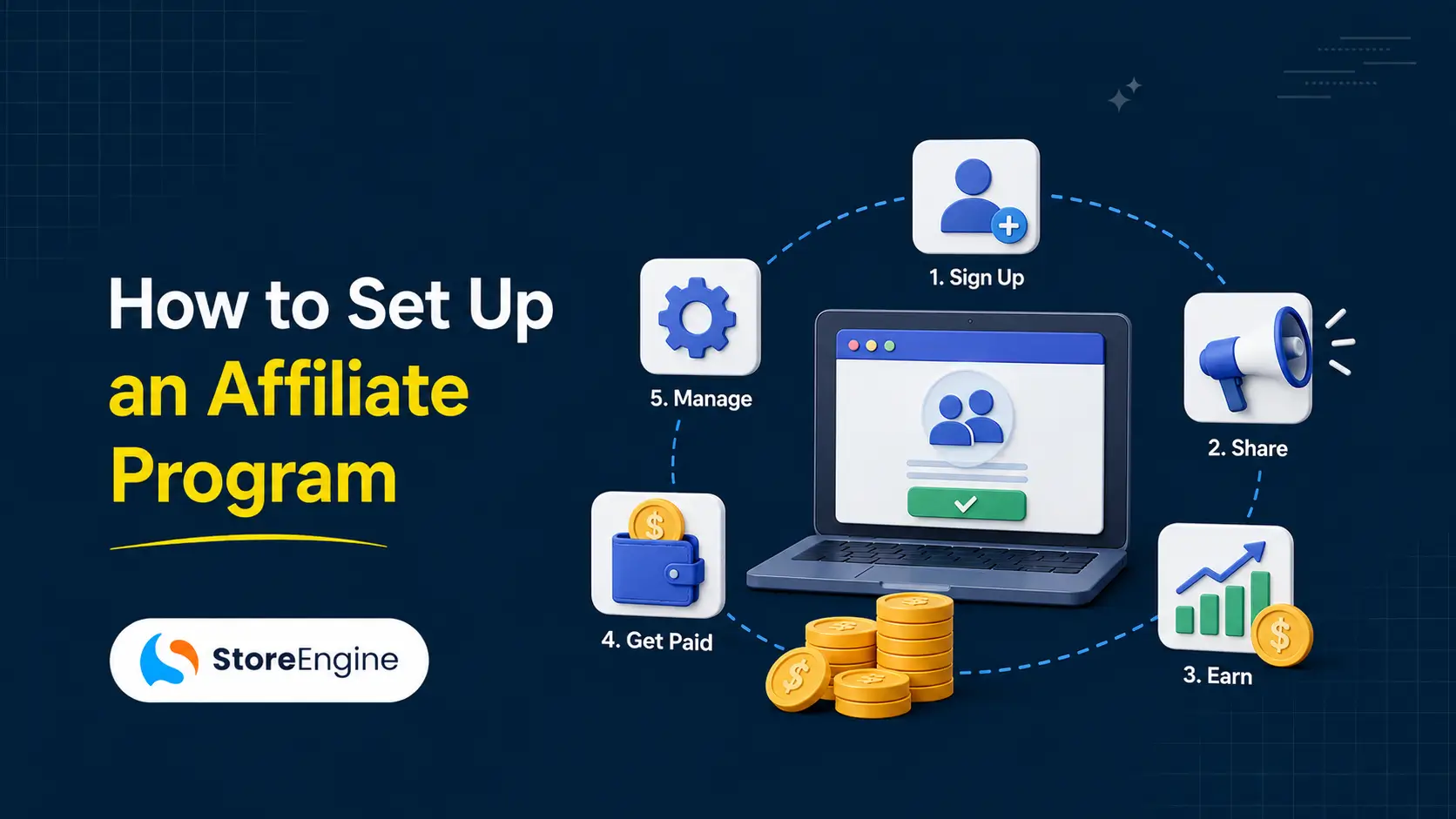

Every day you don’t have an affiliate program running, you’re paying 100% of your customer acquisition cost out of pocket — while your competitors let their customers, fans, and content creators do the selling for them.
Affiliate marketing isn’t a hack. It’s the most capital-efficient growth channel in digital commerce. The global affiliate marketing industry generated $19.6B in 2025 and is projected to reach $24.7B in 2026 — a 26% year-over-year jump. And affiliate marketing now drives 16% of all eCommerce sales.
The brands winning with affiliates aren’t necessarily the biggest ones. They’re the ones who built their program right from day one — clear commission model, proper tracking, and a focused recruitment strategy.
This guide gives you the exact framework to do that. And if you’re running your store on StoreEngine, you’re already one step ahead — it comes with a built-in affiliate system so you can launch your program without stitching together third-party tools.
What Is an Affiliate Program (And Why It Works)
Before you configure a single setting, you need to understand why this model works so reliably.
An affiliate program lets third parties — bloggers, YouTubers, newsletter writers, customers, or niche communities — promote your product using a unique tracking link. When someone clicks that link and buys, the affiliate earns a commission. You only pay for results.
It’s performance marketing without the upfront ad spend risk.
According to Impact.com’s 2025 Industry Benchmark Report, affiliate links now function as research tools as much as purchase drivers — shoppers use them to compare prices and build product knowledge across multiple partners before converting.
That’s the real insight: your affiliates aren’t just closing sales. They’re shaping purchase decisions long before anyone hits your checkout page.
Three models dominate affiliate programs:
|
Model |
How It Works |
Best For |
|
Pay-Per-Sale (PPS) |
Affiliate earns a % or flat fee on each completed sale |
eCommerce, SaaS, digital products |
|
Pay-Per-Lead (PPL) |
Affiliate earns for each qualified signup or inquiry |
B2B, finance, service businesses |
|
Pay-Per-Click (PPC) |
Affiliate earns per click, regardless of conversion |
High-traffic content publishers |
Most eCommerce businesses use PPS. It aligns incentives perfectly — your affiliate only earns when you earn.
Step 1: Define Your Goals Before You Touch Any Software
When you clearly state your program’s goals and target audience, you’ll attract the right affiliates who drive the results you actually want.
Too many businesses skip this and end up with a program full of coupon sites that cannibalize their organic traffic.
Ask yourself:
- Do I want new customer acquisition or do I want to reward existing customers who refer others?
- Am I targeting content creators, micro-influencers, or niche blogs?
- What’s my acceptable cost per acquisition (CPA)?
Before selecting a network or software, calculate your maximum allowable CPA. The formula: (Average Order Value × Gross Margin %) – Fixed Fulfillment Costs = Maximum Commission Budget per Sale.
Run that math first. Everything else flows from it.
Step 2: Choose Your Commission Structure
This is where most programs get it wrong. They either underpay and can’t recruit quality partners, or overpay and bleed margin without meaningful incremental revenue.
2026 commission benchmarks by vertical:
|
Industry |
Typical Commission Rate |
Model |
|
eCommerce / DTC |
10–15% per sale |
Percentage of sale |
|
SaaS / Software |
20–30% recurring |
Revenue share |
|
Finance / Fintech |
50–200 per lead |
Flat CPA |
|
Health & Wellness |
~15% per sale |
Percentage |
|
Travel |
~4.2% per booking |
Percentage |
|
B2B Services |
~$187 per qualified lead |
Flat CPA |
The global average commission rate stands at 9.2% of sale value in 2026, and recurring commission models have grown 68% in popularity since 2023 — among SaaS programs, 43% of advertisers now offer monthly ongoing commissions.
Practical structure tips:
- Launch at 60–70% of your maximum commission ceiling. Leave room to increase rates for top performers.
- Use tiered commissions — reward affiliates who drive more volume with higher rates. Performance tiers are now offered by 56% of larger affiliate programs.
- Set a cookie window of 30 days as your baseline. The average affiliate cookie window is 30 days — only 12% of programs still offer 90-day cookies or longer.
Step 3: Pick Your Affiliate Tracking Platform
You have two routes:
Option A: Join an affiliate network (ShareASale, CJ Affiliate, Rakuten, Impact)
- Gives you access to thousands of pre-vetted publishers instantly
- Handles tracking and payouts
- Less control; network fees apply
Option B: Run your own in-house program
- Full control over the program, the relationship, and the data
- Lower long-term cost
- Requires your own tracking software
For WordPress-based stores, in-house is almost always the smarter play. You own the data, you control the affiliate experience, and you’re not paying a network a cut of every commission.
Step 4: Set Up Your Affiliate Program on WordPress
This is where most tutorials get bogged down in plugin comparisons. Let’s cut through it.
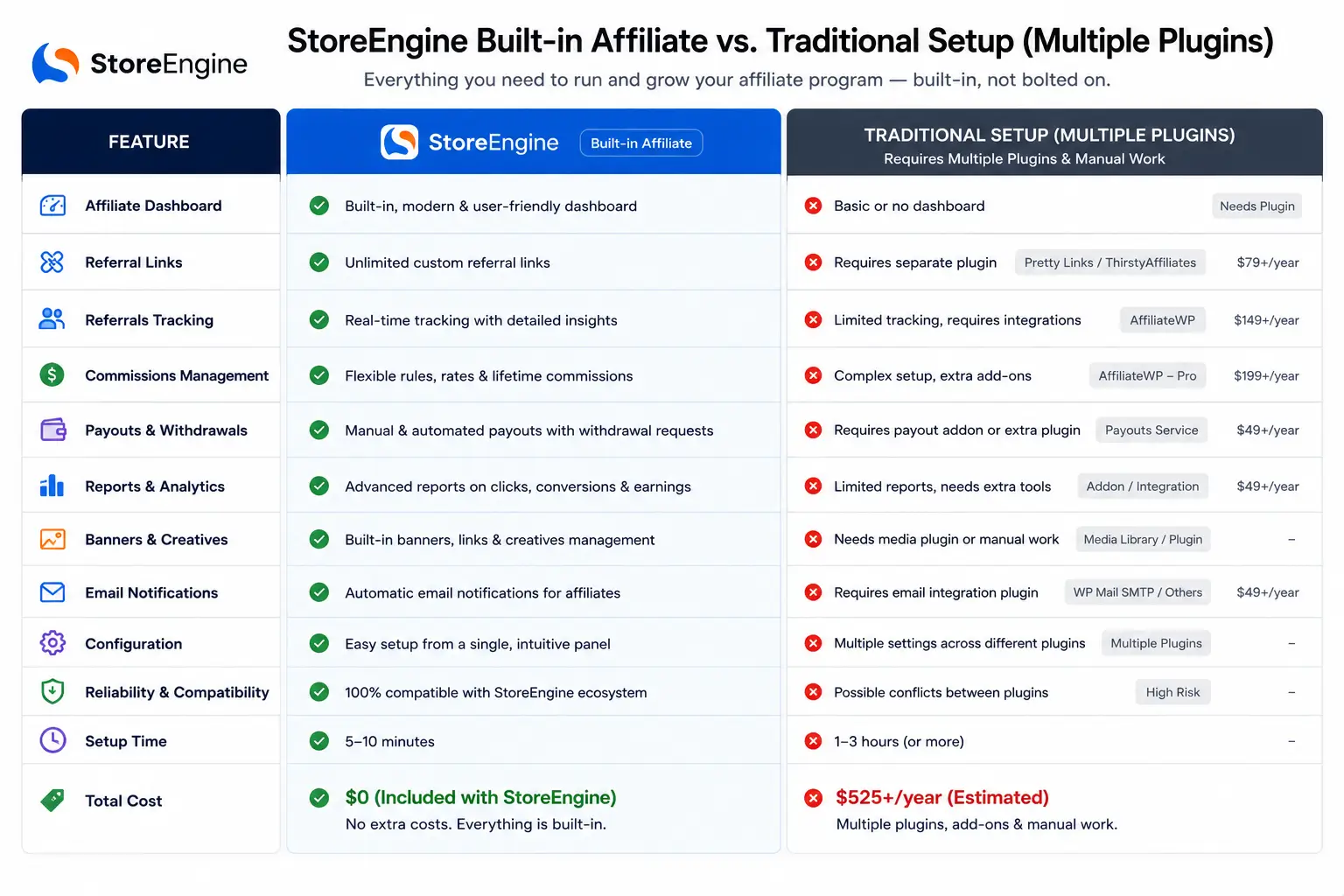
If you’re running a WordPress store, you need two things: a reliable eCommerce engine and an affiliate tracking layer. Traditionally, that meant buying both separately. In 2026, there’s a cleaner option.
The All-in-One Approach: StoreEngine
StoreEngine is a WordPress eCommerce plugin that comes with a built-in affiliate system — no separate affiliate plugin needed, no stack of addons, no extra monthly fees.
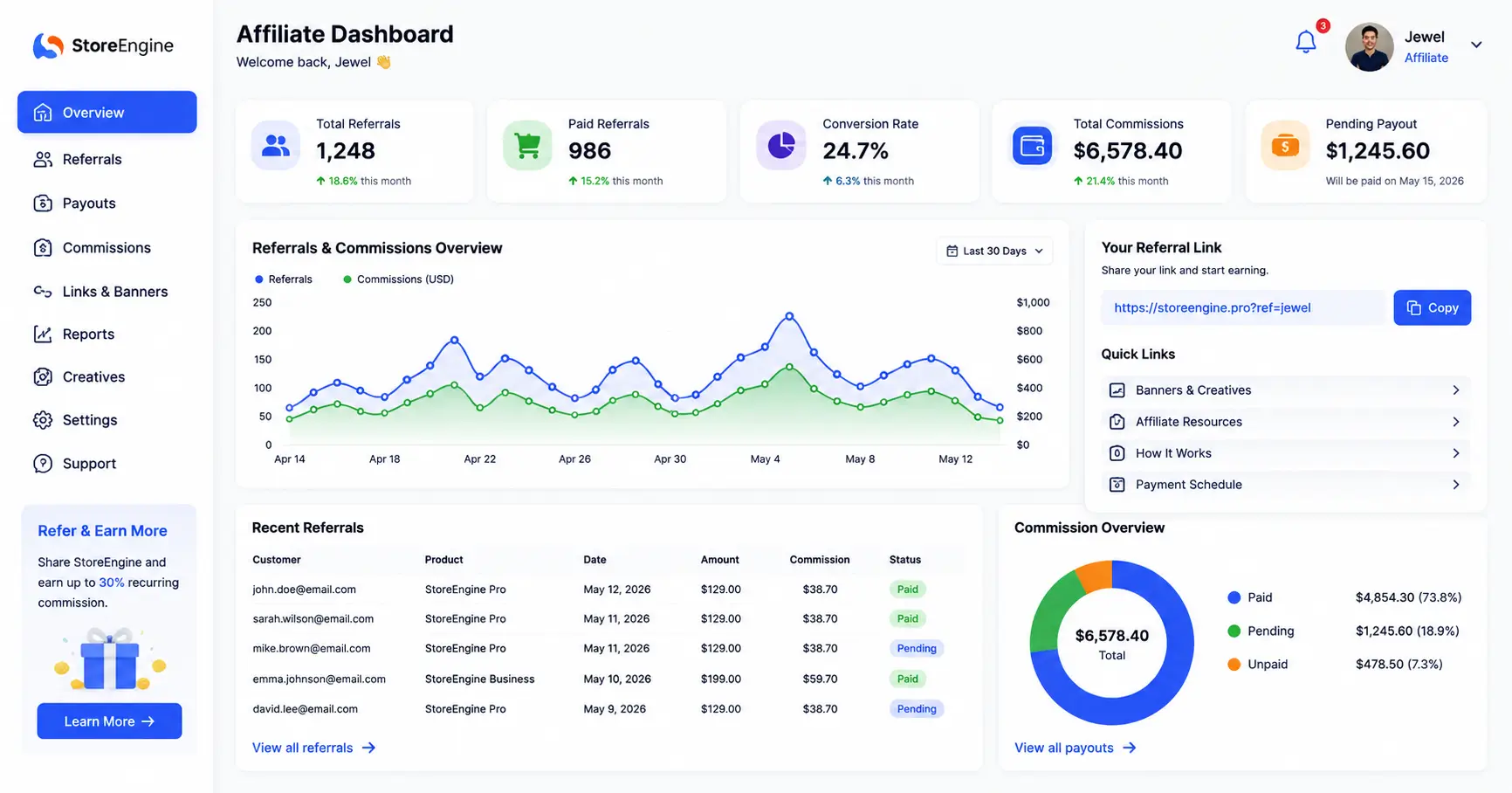
StoreEngine includes a native affiliate system that lets you track referrals, manage payouts, and grow faster — all without extra installs. The affiliate module is included alongside subscriptions, memberships, invoicing, and advanced analytics as part of the core package.
StoreEngine offers referral tracking, commission tiers, and payouts — no third-party affiliate plugin needed.
What StoreEngine’s affiliate system gives you:
- Unique referral link generation per affiliate
- Commission tier configuration (flat rate or percentage)
- Affiliate dashboard where partners can track their own performance
- Payout management directly inside WordPress
- Fraud prevention and referral attribution controls
- Works with Stripe and PayPal out of the box
During testing, StoreEngine’s affiliate system, subscription payments, one-click upsells, and sales tracking were all part of the same bundle — no separate add-ons required to activate them.
For eCommerce store owners who want the cleanest possible setup — one plugin, one dashboard, one cost — StoreEngine is the most pragmatic choice in the WordPress ecosystem right now.
🔗 Explore StoreEngine: storeengine.pro
Setting Up StoreEngine’s Affiliate System: Step-by-Step
Step 1: Install StoreEngine
Install and activate the StoreEngine plugin from the WordPress repository or from storeengine.pro. Connect your payment method (Stripe or PayPal).
Step 2: Activate the Affiliate Module
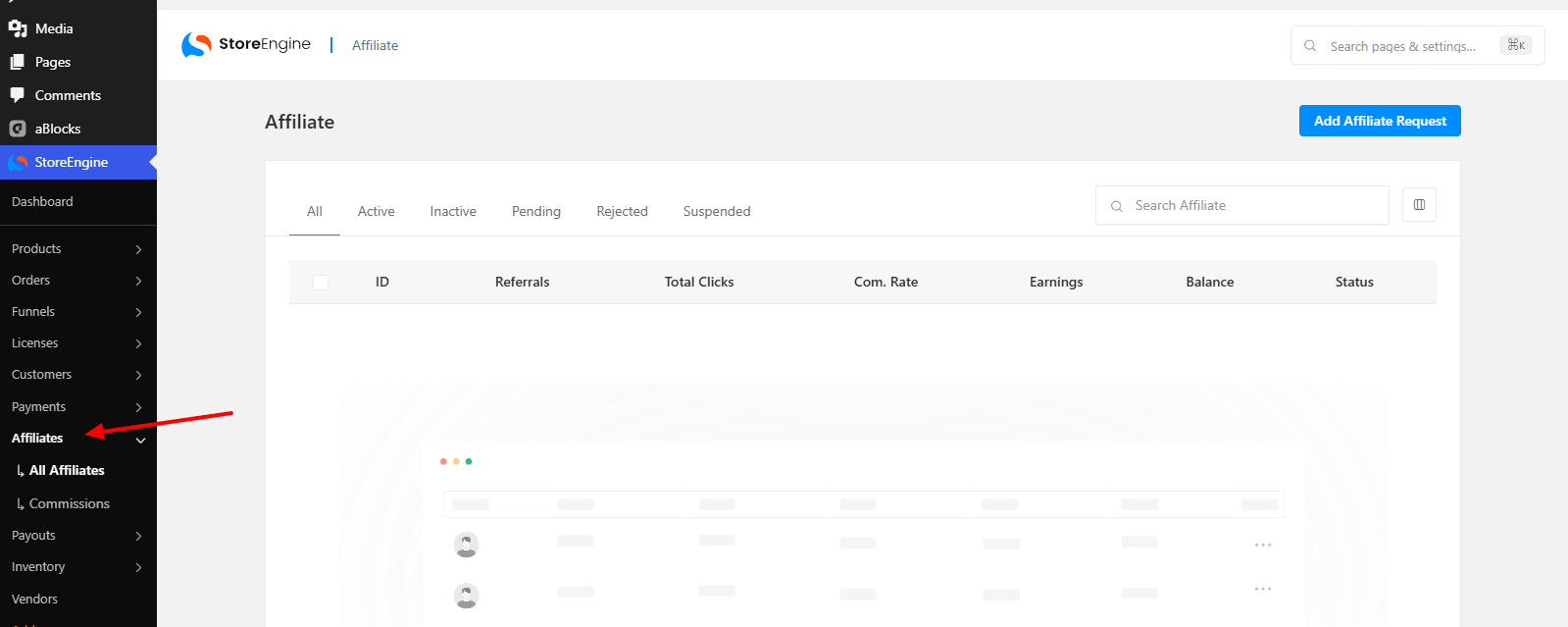
Inside your StoreEngine dashboard, navigate to the Affiliate settings and toggle the affiliate system on. This activates referral link generation and commission tracking with a single click.
Step 3: Configure Your Commission Structure
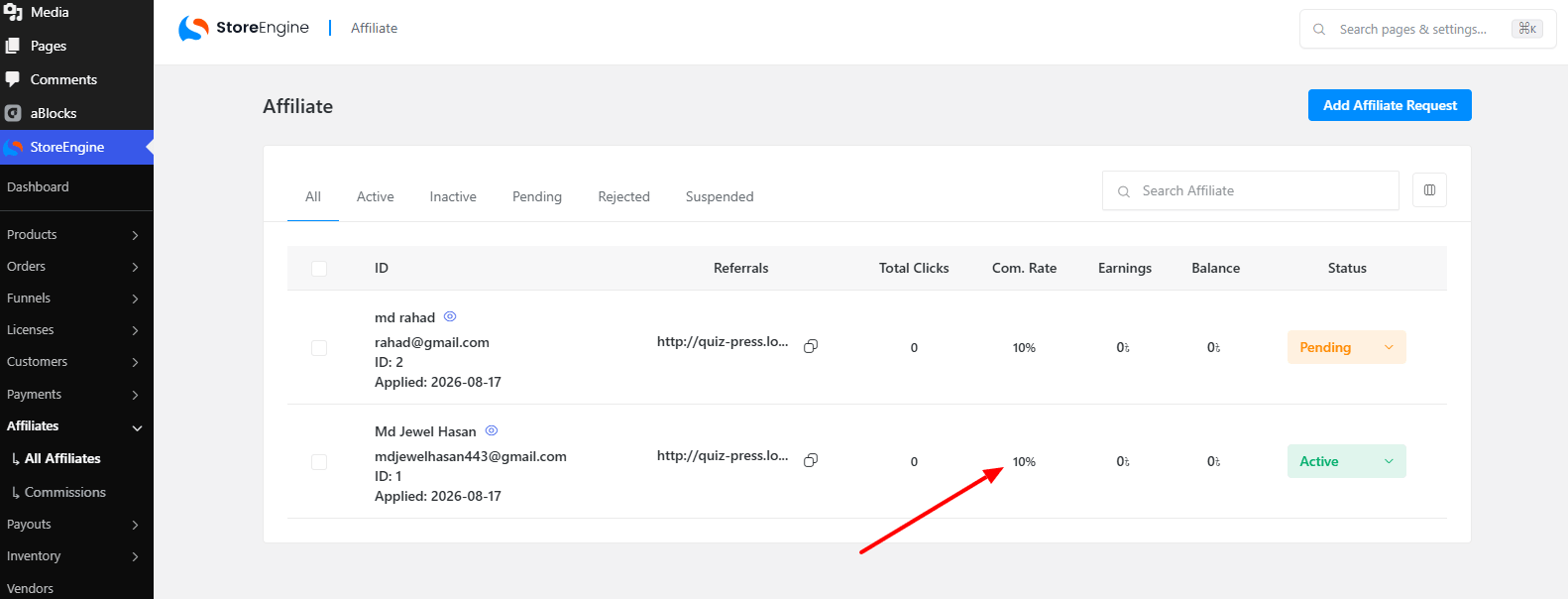
Set your global commission rate — percentage of sale or flat fee. You can create product-level or affiliate-level overrides for specific partners or campaigns.
Step 4: Set Cookie Duration
Configure your referral cookie window. Start at 30 days for most eCommerce use cases.
Step 5: Create Your Affiliate Registration Page
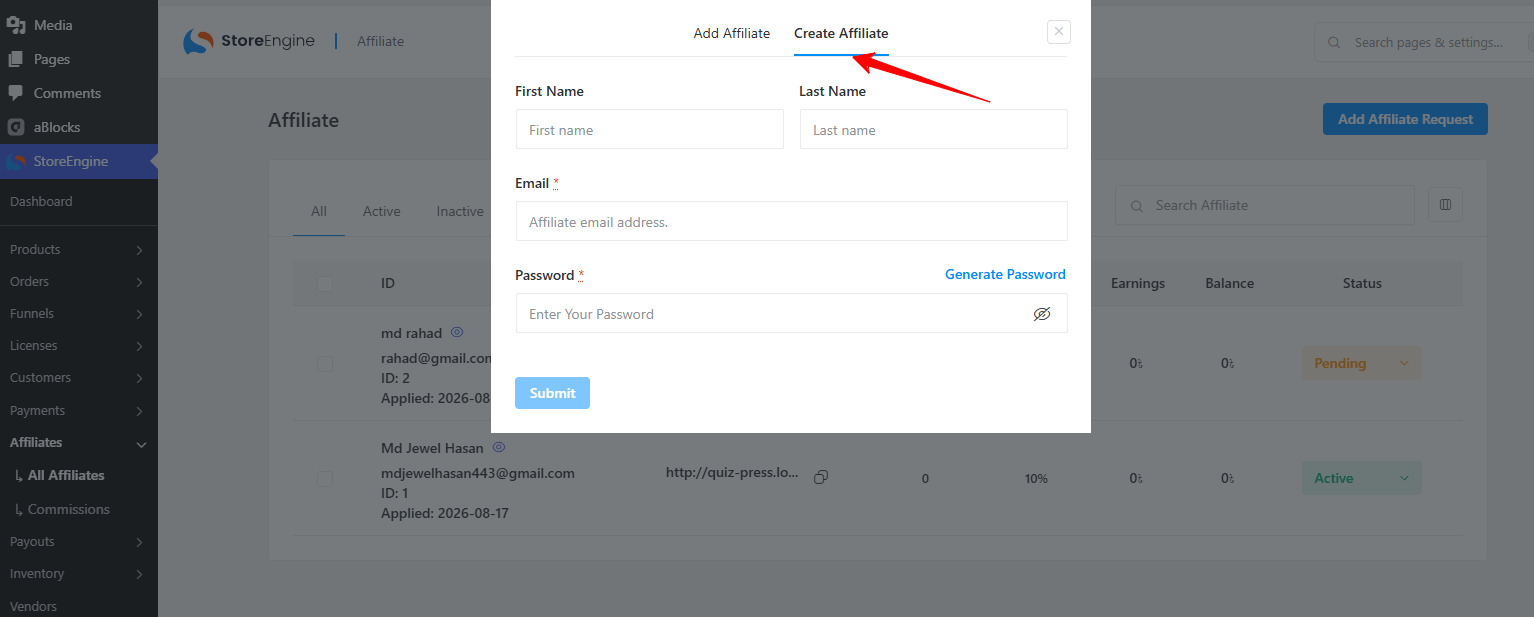
StoreEngine generates an affiliate signup page. Customize the welcome message, required fields, and approval settings (auto-approve vs. manual review).
Step 6: Configure Payout Rules
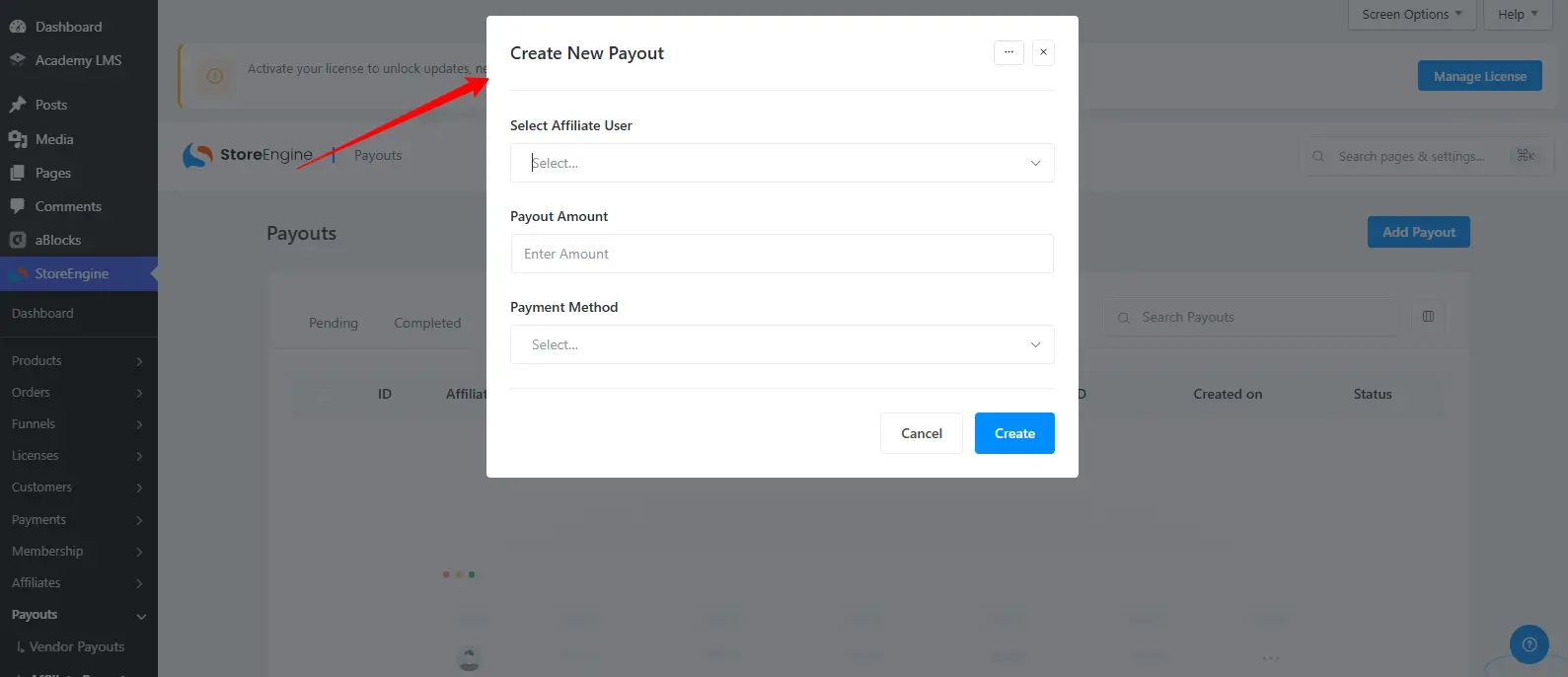
Set your minimum payout threshold (e.g., $50) and payment schedule (monthly, bi-weekly). Connect your payout method.
Step 7: Prepare Affiliate Assets
Upload banners, product images, and email swipe copy to your affiliate resource library. Affiliates who have assets ready perform significantly better in their first 30 days.
Step 8: Test Everything
Place a test order through an affiliate link. Confirm that the cookie fires, the referral is attributed correctly, and the commission appears in the affiliate dashboard. A $1 test order through an affiliate link confirms cookies, attribution, and webhook events before you go live.
Step 5: Write Your Affiliate Program Terms and Conditions
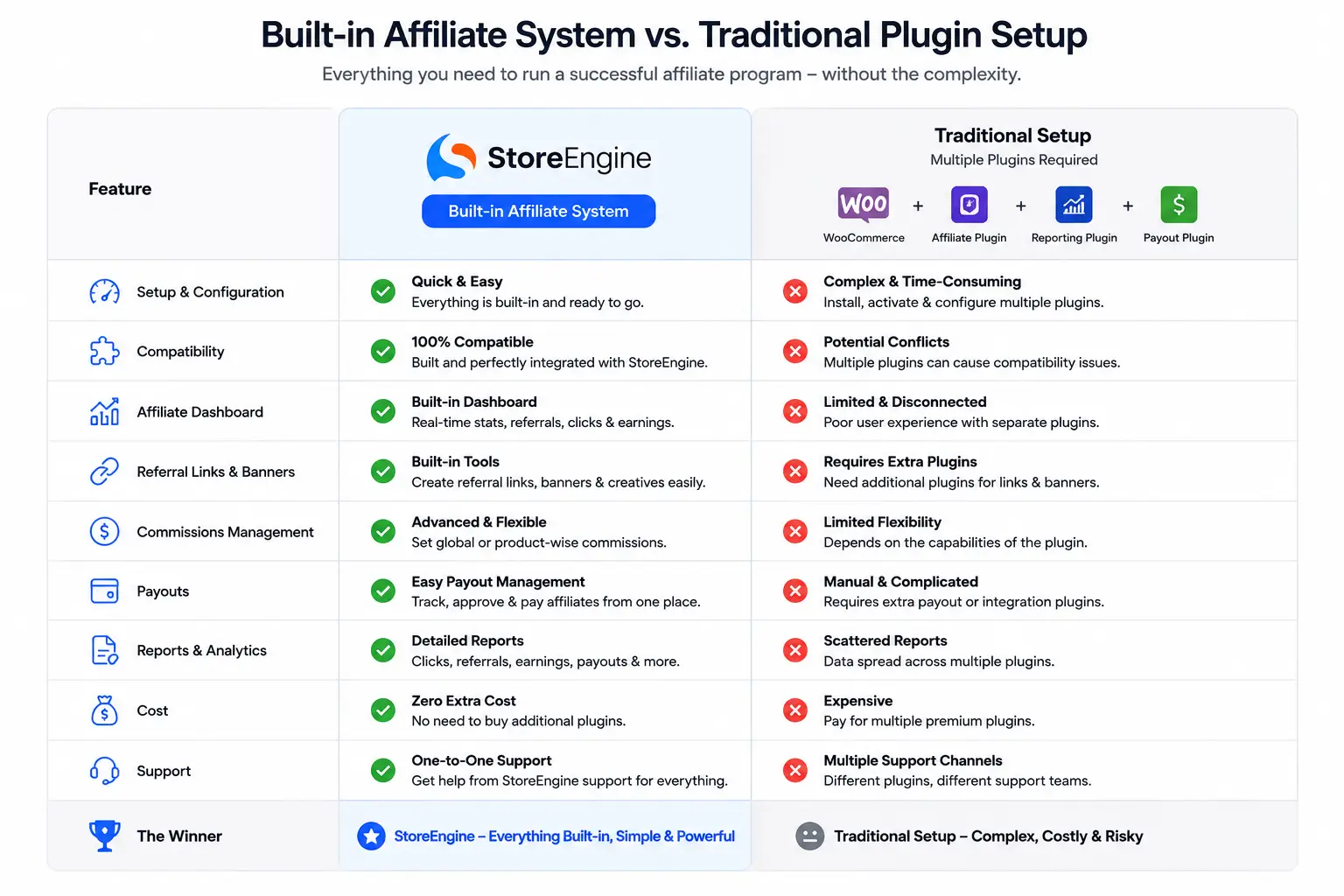
Your T&Cs protect both you and your affiliates. Don’t skip this.
Cover these at minimum:
- Commission rates and when they’re paid
- Cookie duration and attribution rules
- Prohibited promotion methods (paid ads on your brand name, misleading claims, self-referrals)
- FTC disclosure requirements (affiliates must disclose the relationship)
- Fraud and chargeback policy
- Program termination conditions
Keep it clear and plain-language. Affiliates who understand the rules from the start cause far fewer headaches later.
Step 6: Create Your Affiliate Signup Page
Your signup page is your pitch to potential affiliates. It needs to answer three questions immediately:
- What do I promote? (your product in one sentence)
- What do I earn? (commission rate + cookie window)
- How do I get paid? (payment method + schedule)
Add a short “who this is for” section to pre-qualify applicants. This filters out low-quality signups and attracts partners who are genuinely aligned with your audience.
Step 7: Recruit Your First Affiliates
A program with zero affiliates drives zero revenue. Recruitment is where most programs stall.
You can recruit affiliates through multiple channels: affiliate networks like ShareASale, CJ Affiliate, and Rakuten provide access to thousands of pre-vetted publishers; direct outreach to bloggers, YouTubers, and social media influencers in your industry; existing customer relationships — your most passionate customers often make excellent affiliates; and your website’s affiliate signup page.
Priority recruitment sequence:
- Your existing customers first. They already trust the product. A simple email to your list announcing the program will generate your first signups within 48 hours.
- Niche bloggers and YouTubers. Find creators who review products in your category. A personalized outreach email with a pre-approved application link converts well.
- Your email newsletter. Add an affiliate program mentioned to your footer. Passive but consistent.
- Community mentions. Post in relevant Facebook groups, Reddit communities, and Discord servers where your target audience hangs out. (Follow group rules.)
DTC eCommerce programs with an existing customer base typically see their first affiliate-driven sale within 14–21 days of launch, assuming at least 10 active publishers.
The number isn’t “get 500 affiliates.” The goal is 10 genuinely active ones first.
Step 8: Onboard Affiliates Properly
The first 30 days after an affiliate signs up determines whether they ever promote you.
Your affiliate welcome sequence should include:
- A welcome email with their affiliate link and dashboard login
- A quick-start guide (one page, plain language)
- Promotional assets ready to download
- Your commission structure in writing
- A contact point for questions
The most successful affiliate programs treat their affiliates like business partners, not just promotional channels. Schedule regular check-ins with your top performers.
Step 9: Track Performance and Optimize
Once your program is live, the work shifts to data.
Key metrics to monitor:
|
Metric |
What It Tells You |
Benchmark |
|
Conversion Rate |
Quality of affiliate traffic |
1% to 3% typical range |
|
EPC (Earnings Per Click) |
Affiliate profitability signal |
Varies by niche |
|
Active Affiliate Rate |
% of affiliates who actually promote |
Aim for 30–40% |
|
Avg. Commission per Sale |
Payout sustainability check |
Track vs. margin |
|
Affiliate-Driven Revenue |
Program’s total impact |
Month-over-month growth |
Check your data monthly. Low EPC means affiliates aren’t seeing enough conversions to justify effort — investigate landing page quality, offer clarity, or pricing. Low active affiliate rate means your onboarding or assets need work.
Step 10: Scale and Protect Your Program
Scale what’s working: Your top performers generating significant monthly revenue deserve different treatment than dormant affiliates who’ve never referred anyone. Create tiers, offer exclusive perks to top affiliates, and invest your time where it has the highest return.
Protect what you’ve built:
Affiliate fraud is real. Common tactics include self-referrals, cookie stuffing, and fake leads.
Protect yourself with:
- Manual application review for high-commission tiers
- Holdback periods on payouts (hold commissions 30 days to account for refunds)
- Regular audit of suspicious referral patterns
- Clear fraud policy in your T&Cs
AI-augmented affiliate management adoption climbed from 18% of all programs in 2024 to 67% by Q1 2026 — tools now help flag unusual attribution patterns automatically.
Affiliate Program Best Practices (Quick Reference)
- ✅ Calculate your maximum CPA before setting commission rates
- ✅ Start with 10 active affiliates — quality over quantity
- ✅ Provide ready-to-use assets (banners, email copy, product images)
- ✅ Pay on time, every time — trust is your program’s foundation
- ✅ Use a 30-day cookie window as your baseline
- ✅ Require FTC disclosures from all affiliates
- ✅ Test your tracking before you launch publicly
- ✅ Review and adjust commission rates quarterly
- ❌ Don’t let affiliates bid on your branded keywords (unless you explicitly allow it)
- ❌ Don’t auto-approve all applicants for high-commission programs
- ❌ Don’t let the program run on autopilot — active management compounds results
Why WordPress Is the Smart Platform for Affiliate Programs
Using a plugin significantly simplifies the technical aspects, allowing you to focus on recruiting affiliates and growing your program. Installing a plugin, running the setup wizard, and configuring your commission rate usually takes under an hour.
WordPress gives you something hosted platforms can’t: full ownership. Your affiliate data, your commission logic, your payout rules — all on your server, under your control.
And when you use StoreEngine, you’re not stitching together a plugin stack. StoreEngine is currently the only truly free WordPress eCommerce plugin that gives you a full-featured store setup right out of the box — from order and tax management to subscriptions, affiliate, and membership support — all included in the free version.
That means faster launch, lower overhead, and a single dashboard to manage everything.
FAQs: How to Set Up an Affiliate Program
How much does it cost to set up an affiliate program?
With WordPress and StoreEngine, you can launch for free. Most costs come from the plugin license (StoreEngine has a free version with affiliates included) and the time to set up assets and recruit affiliates. Compared to running paid ads, it’s extremely low cost-to-launch.
What commission rate should I offer?
Start at the lower end of your vertical’s benchmark range. For eCommerce, 10–15% is a solid starting point. For digital products with high margin, 20–30% is competitive. Launch at 60–70% of your commission ceiling to preserve room for rate increases as affiliates prove their quality.
How long does it take to see results?
DTC eCommerce programs with an existing customer base typically see their first affiliate-driven sale within 14–21 days of launch, assuming at least 10 active publishers. Patience plus active recruitment is the formula.
Do I need a separate affiliate plugin for WordPress?
Not if you use StoreEngine. StoreEngine’s native affiliate system handles referral tracking, payout management, and affiliate dashboards — all without additional installs.
How do I prevent affiliate fraud?
Use manual review for new applicants, implement a 30-day payout holdback period for refund coverage, audit referral patterns monthly, and include clear fraud terms in your program agreement.
What’s the average affiliate conversion rate?
The average affiliate marketing conversion rate is around 1–2%, though top affiliates can reach 5–10%. Conversion rates vary significantly by product category, price point, and affiliate audience alignment.
Can I run an affiliate program for a WooCommerce store?
Yes — but WooCommerce requires a separate affiliate plugin. If you’re building a new store or open to switching, StoreEngine offers affiliate functionality built directly into the eCommerce core.
Conclusion: Build the Program Once, Let It Work for Years
An affiliate program isn’t a campaign with a start and end date. Done right, it’s infrastructure — a distribution network that compounds over time as more partners find, test, and scale your offer.
The brands that dominate affiliate marketing in 2026 aren’t spending more on it. They built the foundation correctly and then stayed consistent: competitive commissions, proper tracking, genuine affiliate relationships, and regular performance reviews.
Your next move is clear. Define your CPA ceiling. Pick your platform. Set up your first commission structure. Recruit your first 10 affiliates.
If you’re on WordPress and want the cleanest, fastest path to launch — StoreEngine gives you everything in one place. Affiliate tracking, commission management, payouts, and a full eCommerce engine — without the plugin sprawl.
Start building the program that works while you sleep.
🔗 Get StoreEngine: storeengine.pro