


Every ecommerce guide eventually tells you the same thing: retention is cheaper than acquisition. Then it points you at a loyalty app, a subscription platform, a membership plugin, and a separate email tool — four more monthly subscriptions to assemble into something that resembles a retention system.
The math behind that advice is sound. Acquiring a new customer costs 5–7× more than retaining an existing one. A 5% increase in retention boosts profits by 25–95%. Returning customers generate 40% of ecommerce revenue while representing only 8% of all visitors. The numbers are consistent across every study. The problem is that the standard WordPress path to acting on them requires five separate tools that don’t share data and each need their own setup.
Customer retention ecommerce strategy on WordPress with StoreEngine works differently. Subscriptions, memberships, content access control, BOGO and targeted coupons with cart-goal nudges, post-purchase email flows, an affiliate program, and a self-service customer dashboard are all built into the same engine that runs your checkout and order management. This guide covers every retention lever, how each one works mechanically, and which combination fits which type of store.
Quick Answer: What Is Customer Retention in Ecommerce?
Why Retention Beats Acquisition — and Why Most Stores Underinvest
The numbers on this are not subtle. 65% of company revenue comes from repeat buyers, yet most ecommerce stores spend 80% of their marketing budget on acquisition and 20% on retention. That inversion is the most common and most expensive mistake in ecommerce.
At a $50 average order value with a $25 customer acquisition cost, a first-time buyer barely breaks even. The second, third, and fourth purchases are where real margin is made — with zero acquisition cost attached. Subscription customers specifically carry a 4.1× higher lifetime value and a 45% retention rate at 12 months, meaning the highest-value customers are structurally retained rather than re-acquired.
The average ecommerce churn rate is 77% — meaning the typical store loses 77 out of every 100 customers after the first purchase. The gap between 30% retention (average) and 50% retention (top performers) represents doubling your repeat customer base from the same traffic. The financial impact of closing that gap dwarfs most acquisition campaigns.
The retention strategies that move the needle are not complicated: recurring revenue structures that make the second purchase automatic, post-purchase email flows that maintain the relationship, loyalty incentives that reward returning behavior, and an experience quality that removes reasons to leave. StoreEngine builds all four into the store engine itself.
Retention Lever 1 — Subscriptions: Making the Next Purchase Automatic
The highest-impact retention mechanism in ecommerce is also the most structural: converting a one-time purchase into an ongoing subscription. A subscriber doesn’t decide to come back — they’re already committed. That’s why subscription customers retain at 45% after 12 months versus 30% for non-subscribers, and why their lifetime value is 4.1× higher.
StoreEngine’s Subscription addon turns any product into a recurring billing product natively, without WooCommerce and without a third-party subscription platform.
What the subscription engine covers
Any product can be given a subscription price type. The merchant sets the billing amount and interval — daily, weekly, monthly, quarterly, yearly — and StoreEngine handles the rest: charging the saved payment token on schedule via Action Scheduler, creating renewal orders, managing subscription status through nine internal states, and firing the appropriate email at each lifecycle event.
The nine statuses — pending, active, pending_payment, renewed, on_hold, expired, draft, archive, cancelled — give the system precise control over every lifecycle scenario. A failed renewal payment moves the subscription to on_hold rather than immediately cancelling it, giving the customer a window to update their payment method. The renewal failed email fires with a direct retry link ({retry_url}, {retry_button}), which is the primary mechanism for recovering a lapsed renewal before it becomes permanent churn.
Free trials and signup fees
StoreEngine subscriptions support both free trials (configured as a number of trial days, with the trial_end_date tracked for the “trial ending soon” email) and signup fees charged once at the beginning of the subscription. These are the two mechanics that drive subscription acquisition — a free trial removes the commitment barrier for new subscribers, and a signup fee creates a price anchor that makes the recurring billing feel proportionally lower.
Mixed cart: subscription and one-time together
StoreEngine supports adding a subscription product and a one-time product to the same cart — completing as a single checkout with the one-time charge processed immediately and the subscription set to renew on its configured schedule. This enables upsell patterns where a physical product (one-time) ships with a software plan or membership (subscription) in a single transaction. No split checkouts, no second purchase decision required. See how this connects to overall ecommerce conversion rate optimization — removing checkout friction extends to recurring purchase setup.
Subscription coupons
The RecurringCoupon event allows coupons to apply to subscription renewals, not just the initial purchase. This enables subscriber-only offers — a discount that applies to the first three renewal billing cycles, for example — as a retention incentive for subscribers at risk of cancelling.
Retention Lever 2 — Memberships: Gating Value That Keeps Customers Engaged
Memberships create retention through access rather than repurchase. A customer who has paid for a membership tier has an ongoing reason to stay — not because they have to reorder, but because their access to something valuable depends on maintaining the relationship. That’s a fundamentally different retention mechanism, and it compounds over time as the member engages with more of the content or benefits inside the tier.
StoreEngine’s Membership addon is built on an access group system. You create access groups (tiers), assign products or prices to them, and configure which content, products, or site areas each group can access.
Block-level content restriction
The most granular restriction in the system is block-level. Every WordPress block in the Gutenberg editor gains a StoreEngine visibility panel in the inspector. You assign access groups to the block — and on the frontend, the block is simply omitted for users who don’t qualify. The restriction enforces through the render_block filter, so even if someone views the page source, the restricted content is not present in the HTML — it was never rendered. The rest of the page displays normally. This means you can gate specific sections of a post (the detailed tutorial step, the downloadable resource, the pricing breakdown) while leaving the teaser visible to everyone.
Page, product, and navigation restriction
Beyond individual blocks, the addon restricts entire pages and posts via REST API guards and template redirects, gates products so they’re only purchasable by members of the relevant tier, and hides navigation menu items from non-members. A multi-tier membership site — where each tier sees different menu items, accesses different content, and can purchase different products — is configurable without code.
Access expiry
Each access group supports an expiration date. When a member’s access expires, the restriction becomes active again automatically — gating content they previously accessed. This works with subscription-gated memberships: when the subscription lapses, membership access expires.
Membership analytics on the dashboard
The main StoreEngine analytics dashboard includes membership tiles: total member count and total access group count, both displayed in the OverviewCards section. These appear alongside order and revenue analytics, giving a complete picture of your recurring customer base rather than separating membership data into a separate report.
Retention Lever 3 — Cart-Goal Nudges and Targeted Coupons
Loyalty programs drive retention by creating an incentive structure that rewards return behavior. StoreEngine’s Advanced Coupon addon (Pro) builds this natively through three connected systems: cart-goal nudges that show discount progress in real time, targeted coupons delivered to specific customers in their dashboard, and BOGO offers that reward quantity purchase.
Cart-goal nudges: “Spend $X more to unlock 20% off”
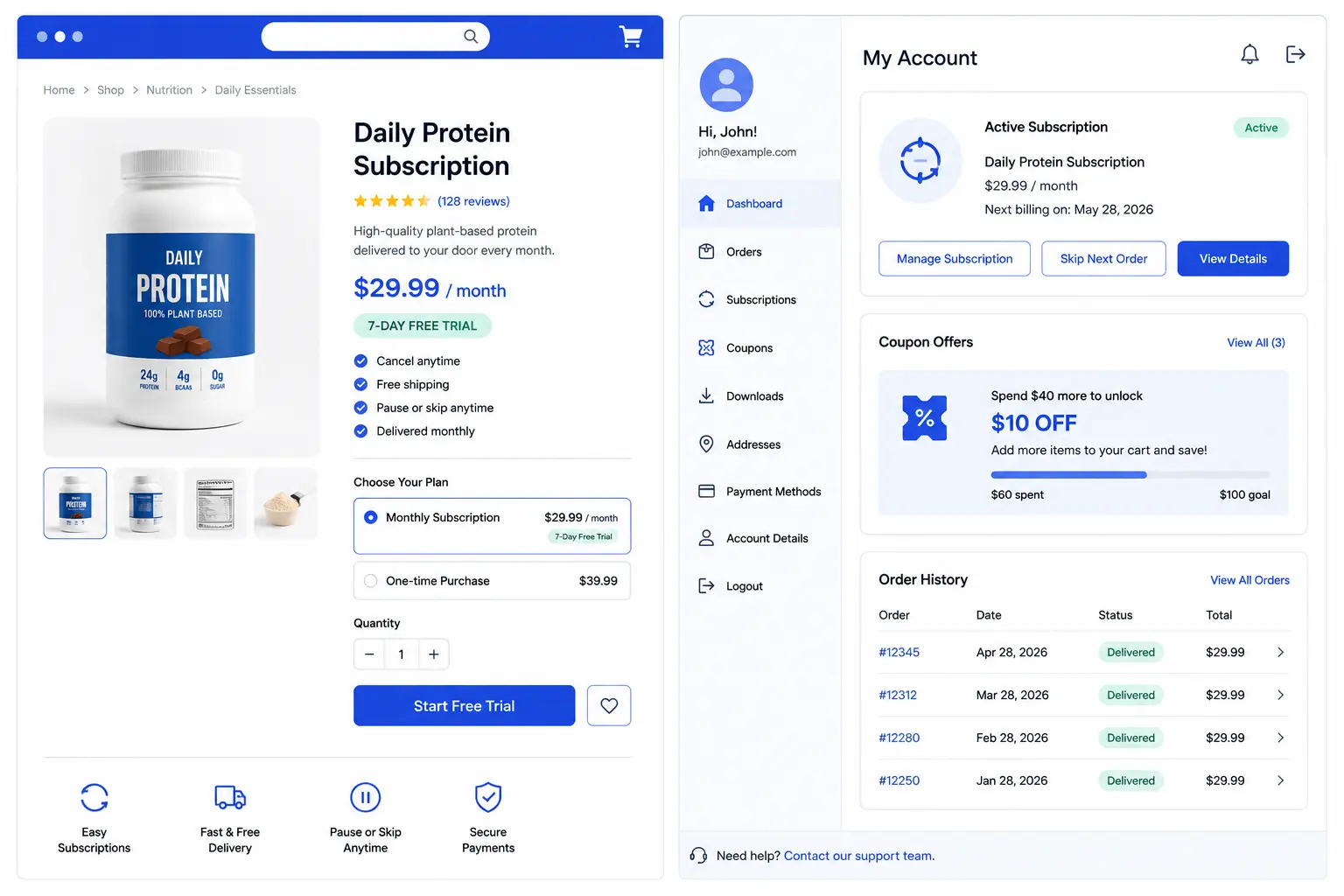
When a coupon is marked as “Promote in cart” in the coupon settings, StoreEngine’s Suggestion Engine activates it as a cart nudge. Shoppers see the offer — and their progress toward unlocking it — directly in the cart and checkout summary.
The system has three states for each promoted coupon. If the shopper’s cart total is below the minimum spend threshold, they see “Spend $12 more to unlock 20% off (SAVE20)” along with a progress bar that fills as they add items. When they’ve crossed the threshold but haven’t applied it, they see “Apply SAVE20 to get 20% off” with a one-click apply link. If they’re already over the threshold and the coupon is applied, the offer disappears. Up to two nudges show simultaneously — capped deliberately to prevent the UI from feeling like a nag.
This is the cart-progress mechanic that specialty retail stores use to drive higher average order values and repeat purchase behavior. StoreEngine builds it directly into the checkout flow, with no separate loyalty app or custom development required.
Customer dashboard coupons
Available coupons surface on the customer’s dashboard — both the admin-promoted coupons and any coupons explicitly targeted to that specific customer by their user ID. A customer logging into their account sees their available offers with the same messaging the cart nudge uses (“Spend $X more to use SAVE20”), creating a reason to engage with the account area and a pull-through to the next purchase.
The targeting system is specific: a coupon can have a list of valid customer IDs, meaning you can create a personal win-back offer for a customer who last purchased 90 days ago and surface it exclusively in their dashboard — not to anyone else.
BOGO (Buy X Get Y Free / at % off)
Buy-X-Get-Y offers are configured per coupon: buy quantity, get quantity, and the discount on the “get” items (0% = full price, 100% = free). The discount headline generates automatically — “Buy 2 Get 1 Free” or “Buy 3 Get 2 at 50% off” — and surfaces in the cart nudge, the checkout summary, and the customer dashboard. When the qualifying purchase is in the cart, a “You unlocked 1 free [Product Name] — Add it to my cart” notice appears, with a direct add-to-cart link.
For retention, BOGO offers work particularly well as a mechanism to increase purchase frequency: a “Buy 2 Get 1 Free” on a consumable product creates a natural reason to buy more in the same session, shortening the replenishment cycle and increasing the units per transaction simultaneously.
Retention Lever 4 — Post-Purchase Email Flows
The post-purchase period is where most ecommerce retention is won or lost. A customer who hears nothing after buying has no reason to think about your store until they need the product again. A customer who receives a shipping notification, a delivery confirmation, a review request, and a relevant follow-up offer has four touchpoints in the days after purchase — and each one is an opportunity to reinforce the relationship.
StoreEngine’s Email addon handles the transactional post-purchase layer natively. As covered in detail in StoreEngine’s email marketing ecommerce guide, every order event fires a configurable email: confirmation (with order details), status change (with before/after status), item shipped (with tracking link and courier name), delivered (with tracking confirmation), invoice, and refund.
The key retention emails in this stack are:
Delivered email — fires when the Couriers addon’s background polling confirms delivery. Variables include {shipment_tracking_link} and {shipment_courier}. Sending a delivery confirmation rather than letting the package arrive silently creates a natural touchpoint to request a review, introduce the next product category, or offer a discount on a complementary item.
Subscription lifecycle emails — trial ending soon (advance notice before the first charge), renewal receipt (confirmation the subscription is active and renewed), and renewal failed (with a retry link). These are the emails that reduce subscription churn by keeping the customer informed and removing friction from the payment recovery path.
Three-email abandoned cart sequence — first at 1 hour, second at 24 hours, third at 5 days, each with configurable content, a cart restore token, and an optional recovery discount that can be timed to appear in the second or third email rather than the first. For the complete mechanics, see How to Reduce Cart Abandonment on WordPress.
Retention Lever 5 — Affiliate Program: Turning Customers Into Advocates
The highest-retention customer is one who refers other customers. Referred customers are 4× more likely to purchase and carry a 16% higher lifetime value than customers acquired through other channels. An affiliate program converts your best customers into an extension of your acquisition channel — and because they’re earning commissions on referrals, their own engagement with the store is reinforced.
StoreEngine includes a full affiliate program natively. Affiliates get a personal referral code, tracked via cookie, with commission calculated on referred purchases and managed through an in-dashboard withdrawal flow. The program automates every communication point: application received, approved (with referral code), commission earned, commission approved, and payout completed. For the complete mechanics, see StoreEngine’s affiliate plugin for WordPress guide.
The retention angle here is dual: the customer who becomes an affiliate is the most retained customer you have (they’re actively promoting your store), and the customers they refer enter with social proof backing rather than as cold acquisitions, giving them a higher starting retention probability.
Retention Lever 6 — Returns Experience: Preventing Post-Purchase Churn
Repeat buyers spend 67% more per order, but return rates erode 20–30% of that revenue when the returns experience is poor. A frustrated return is one of the highest churn triggers in ecommerce. A smooth return experience is one of the most underrated retention tools.
StoreEngine’s Returns/RMA addon gives customers a self-service return flow and ensures every return has a defined outcome. The customer initiates a return from their account, selects the items and reason, and receives a confirmation. The admin approves it and the system sends the return address. When items arrive, the admin marks them received — triggering automatic inventory restock at the correct location. Refund confirmation fires as the final step.
Five emails fire automatically through the lifecycle: request received, approved, customer shipped, warehouse received, and refunded. A customer who returns a product and gets a clean, communicative experience is more likely to reorder than one who submits a return request and hears nothing for a week.
Combined with accurate product descriptions (reducing expectation mismatches that drive returns in the first place) via StoreEngine’s AI content generation, the Returns system addresses both the symptom (a bad return experience) and a root cause (descriptions that don’t match the actual product).
Retention Lever 7 — The Customer Dashboard: A Reason to Return to Your Store
Every retention strategy above requires the customer to engage with your store. The customer dashboard is where that engagement lands. StoreEngine’s self-service customer portal gives every account holder a single place to view orders, manage subscriptions (view, track, cancel), access downloads and license keys, check installment plan schedules, and update payment methods — without contacting support.
The Advanced Coupon addon adds available discount offers to the dashboard overview, so a returning customer logging in to check their order also sees their active promotions. This creates a pull mechanism: the dashboard is a reason to visit the store, not just a customer service touchpoint.
Which Retention Strategy Fits Your Store Type
Not every retention lever applies equally to every store. Here’s how to sequence them by store type.
|
Store type |
Priority 1 |
Priority 2 |
Priority 3 |
|
Physical goods / consumables |
3-email abandoned cart recovery |
Subscription (auto-replenishment) |
Cart-goal nudges + BOGO |
|
Digital products / software |
License management + delivery emails |
Affiliate program |
Targeted dashboard coupons |
|
Courses / content |
Membership (content gating) |
Subscription (drip access) |
Trial → paid conversion email |
|
Subscription-first (box / SaaS) |
Subscription lifecycle emails |
Trial ending soon email |
Renewal failed + retry email |
|
Marketplace |
Vendor + affiliate combined |
Multi-vendor email notifications |
Per-vendor subscription options |
The sequences above represent the highest-ROI starting point for each store type — not an exhaustive strategy. In every case, the email flows come first because they require the least setup relative to the revenue they recover, as detailed in StoreEngine’s email marketing guide.
Setting Up a Retention System in StoreEngine: The Order That Works
Step 1 — Email flows first (week 1). Enable the Email addon, review and customize every transactional template, then activate the Abandoned Cart addon and configure the three-email sequence with your cut-off time and recovery discount on the second email. This is the highest-ROI setup relative to time invested. Reference the checkout optimization guide to ensure the cart restore link lands on a frictionless checkout.
Step 2 — Add subscriptions or memberships (week 2–3). Based on your store type from the table above, activate either the Subscription addon or the Membership addon. For subscriptions: configure billing intervals and enable the trial-ending-soon and renewal-failed email templates. For memberships: create your first access group, assign content restrictions, and verify the block-restriction is working on a test page.
Step 3 — Activate cart-goal nudges (week 3–4). In StoreEngine Pro, activate the Advanced Coupon addon. Create your first promoted coupon with a minimum spend threshold, enable “Promote in cart,” and verify the cart nudge appears with a progress bar when the cart is below the threshold. Check the customer dashboard to confirm the coupon appears there as well.
Step 4 — Launch the affiliate program (month 2). Activate the Affiliate addon, configure commission rate and cookie window, and set up the six affiliate email templates. The affiliate program works best after you have an existing customer base — reach out to your top 20 buyers first. Full setup is in StoreEngine’s affiliate program guide.
Step 5 — Enable returns system (month 2). Activate the Returns/RMA addon, configure the return window, and verify the five lifecycle emails are customized. For context on how a strong post-purchase experience connects to your broader fraud prevention strategy, see how OTP verification and returns work together to reduce both fraudulent orders and legitimate return friction.
Frequently Asked Questions
What is customer retention in ecommerce?
Customer retention in ecommerce is the practice of getting existing customers to purchase again — by creating ongoing value (subscriptions, memberships), staying present with post-purchase email flows, providing loyalty incentives (coupons, BOGO), and delivering a quality experience that removes reasons to leave. The average ecommerce retention rate is 30–31% in 2026, with top performers reaching 45–55% through structured retention programs.
Why is customer retention more profitable than acquisition?
Acquiring a new customer costs 5–7× more than retaining an existing one, and returning customers spend 67% more per order than first-time buyers. A 5% increase in retention boosts profits by 25–95% because every repeat purchase has a near-zero acquisition cost. Email flows and subscription structures compound over time — once configured, they generate revenue continuously without incremental spend.
How do subscriptions improve ecommerce retention?
Subscriptions convert a one-time buying decision into an ongoing commitment, removing the need for the customer to actively decide to return. Subscription customers have a 45% retention rate at 12 months and 4.1× higher lifetime value than non-subscribers. In StoreEngine, subscriptions support free trials, signup fees, nine lifecycle status states, and automatic renewal emails — including a renewal-failed email with a direct retry link that recovers lapsed renewals before they become churn.
How does membership differ from subscription for retention?
Subscriptions retain customers through recurring billing on a product. Memberships retain customers through ongoing access to content, products, or pricing that only exists within the membership. The retention mechanism is different: subscribers are retained by the product value; members are retained by access value. StoreEngine supports both natively — subscriptions through the Subscription addon and content-gated access groups through the Membership addon, including block-level restriction, page/post gating, and nav menu restriction.
What are cart-goal nudges and how do they help retention?
Cart-goal nudges are in-cart messages that show a shopper how close they are to unlocking a discount: “Spend $12 more to unlock 20% off.” StoreEngine’s Advanced Coupon addon powers these through the Suggestion Engine — promoted coupons appear as nudges in the cart, checkout, and customer dashboard, with a progress bar tracking spend toward the threshold. For retention, these create a behavioral incentive to add one more item per visit, increasing per-session revenue from returning customers.
Does StoreEngine require WooCommerce for retention features?
No. StoreEngine is a standalone WordPress ecommerce plugin. Subscriptions, memberships, the affiliate program, the abandoned cart email sequence, the returns system, and the Advanced Coupon cart-goal nudges are all built into StoreEngine without WooCommerce. This means one plugin to update, one admin to navigate, and one system where customer data from subscriptions, orders, memberships, and coupons is all connected.
What is the most important retention email to set up first?
The abandoned cart recovery sequence delivers the highest return per hour of setup. A three-email cart sequence generates 6.5× more revenue than a single reminder, with the first email capturing 45–55% of the sequence’s total revenue. Configure the first email to send within 1 hour of abandonment, include a cart restore token, and hold the recovery discount for the second or third email to avoid discounting customers who would have returned without one.