


You’ve built something worth paying for. Now comes the harder question: how should people pay for it?
Most business owners pick “subscription” or “membership” almost at random — because it sounds right, or because a competitor does it. That’s a costly mistake. The model you choose shapes everything: your revenue predictability, your churn rate, your customer relationships, and your long-term brand equity.
Here’s the truth: membership and subscription are not the same thing. And confusing them doesn’t just muddy your marketing — it sets the wrong expectations for your customers before they even sign up.
That’s exactly the kind of problem StoreEngine was built to solve. Whether you want to run a subscription, a membership, or both — StoreEngine gives WordPress businesses a single, clean platform to launch and manage recurring revenue without the usual plugin chaos. But before you set it up, you need to understand which model actually fits your business.
Let’s clear this up, once and for all.
The Subscription Economy Is Exploding — And the Stakes Are High
Before we get into the mechanics, let’s set the scene.
The global subscription economy market was valued at approximately $557.7 billion in 2025 and is projected to reach $2,516.5 billion by 2035, growing at a CAGR of 16.3%.
Consumer adoption is near-universal: 78% of adults maintain at least one active subscription, with the average person holding around 6.7 subscriptions simultaneously.
Subscription businesses have collectively achieved 17.5% growth over the past decade compared to just 3.8% for the S&P 500 — a 4.6x performance advantage.
These numbers explain why every smart founder is thinking in terms of recurring revenue. But recurring revenue alone doesn’t tell you which recurring model to build. That’s where membership vs subscription becomes the pivotal decision.
What Is a Subscription Model?
A subscription is a financial agreement where a customer pays a recurring fee — monthly, quarterly, or annually — to access a product, service, or content for a defined period.
Think Netflix. Spotify. Adobe Creative Cloud. Canva Pro.
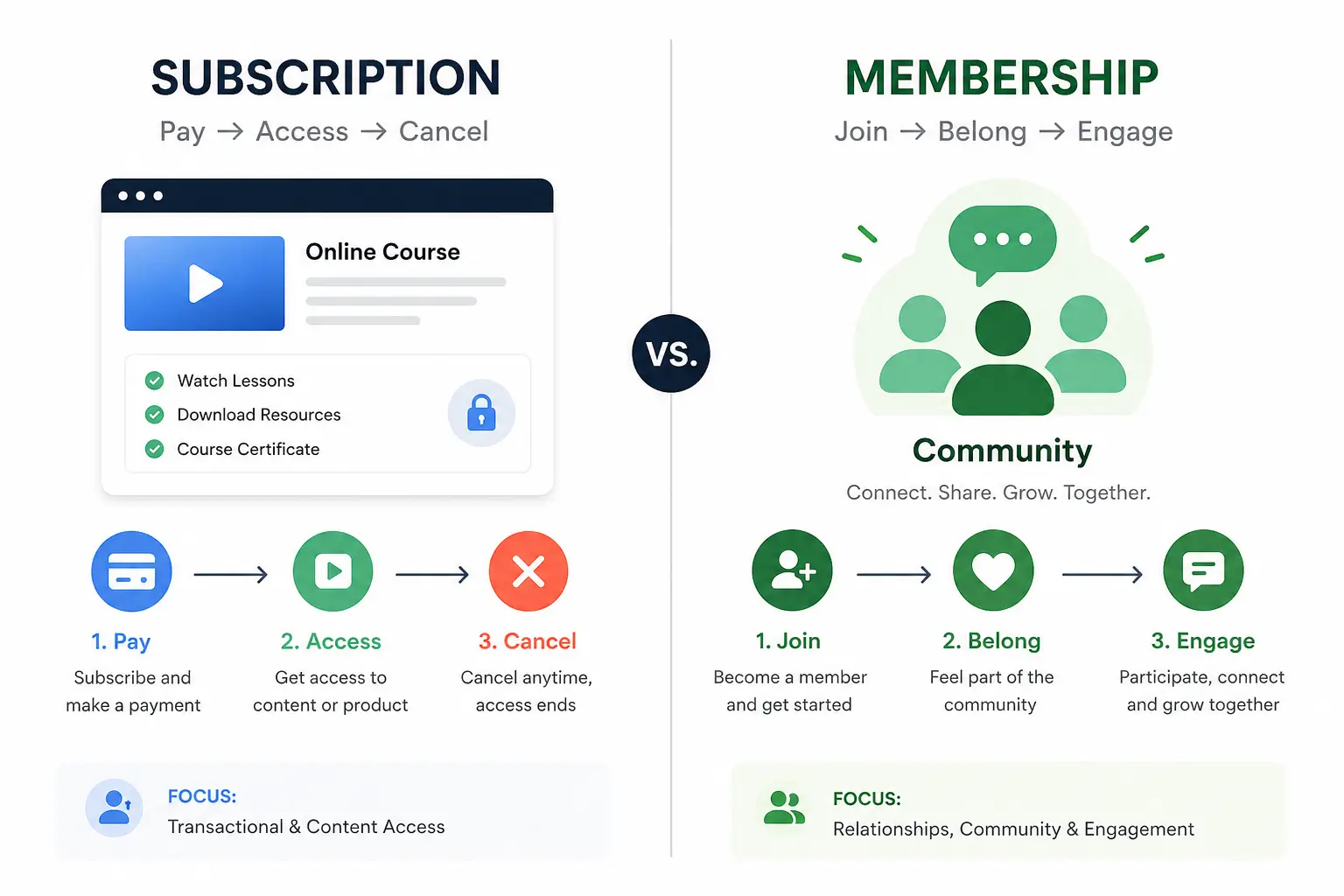
The value exchange is clean and transactional: you pay, you get access, you stop paying, you lose access. There’s no identity tied to it, no community around it, no sense of “belonging.” It’s a utility arrangement dressed in a recurring billing cycle.
Core characteristics of a subscription:
- Predictable, time-bound access
- Automated recurring billing
- Product or content-focused
- Easy to cancel, easy to restart
- Value is delivered to the customer, not with them
Subscription models shine when your product delivers consistent, on-demand value — and the customer doesn’t need a relationship with you to get it.
What Is a Membership Model?
A membership is a relationship agreement where a customer pays a fee (recurring or one-time) to belong to an exclusive group — and gains access to benefits, community, identity, and privileges tied to that belonging.
ThinkThrive Market. Costco. A professional association. A gym. A private mastermind group.
The difference is subtle but powerful: membership sells identity and access. The customer isn’t just buying content or a tool — they’re joining something. They’re a “Thrive Market member,” not an “Thrive Market subscriber.”
Core characteristics of a membership:
- Centered on community and belonging
- Access to exclusive perks, discounts, or privileges
- Identity-driven (“I’m a member”)
- Higher perceived value and stickiness
- Value is created within the community, not just delivered by you
Memberships retain better because leaving means losing your place — not just canceling a service.
📊 Membership vs Subscription: Side-by-Side Comparison
|
Factor |
Subscription |
Membership |
|
Core Value |
Product/content access |
Belonging + exclusive benefits |
|
Billing Structure |
Recurring (monthly/annual) |
Recurring or one-time fee |
|
Customer Identity |
Subscriber |
Member |
|
Community Element |
Rare |
Central |
|
Exclusivity |
Low to moderate |
High |
|
Churn Driver |
Price or lack of use |
Loss of community/privileges |
|
Best For |
SaaS, content, tools |
Courses, communities, eCommerce loyalty |
|
Pricing Flexibility |
High |
Moderate |
|
Cancellation Friction |
Low |
Moderate to high |
|
Examples |
Spotify, Canva |
Thrive Market, Costco, gym memberships |
The Key Differences That Actually Matter
1. Community vs. Content
This is the fundamental split. Subscriptions deliver content or access. Memberships deliver community and belonging.
A subscriber watches your course videos. A member watches them and then discusses them in a private forum, connects with peers, and gets live Q&A access to you. Same underlying asset — completely different experience and retention profile.
As AccessAlly puts it: members stay because the experience continues to develop — through accountability, interaction, and shared progress.
2. Exclusivity and Identity
Membership carries a status signal. When someone tells a colleague “I’m a Costco member” or “I’m part of this mastermind,” there’s social currency attached. Subscriptions don’t do that — nobody says “I’m a Dollar Shave Club subscriber” with pride.
That identity attachment is retention gold. It’s why membership churn tends to be lower than subscription churn when the community is genuinely valuable.
3. Pricing Psychology
Subscriptions are typically priced lower and feel more accessible — you’re selling a utility. Memberships command premium pricing because they sell an experience, status, and community.
Interestingly, memberships can also use one-time fees (like Costco’s annual $65 membership) rather than monthly billing — something subscriptions almost never do.
4. Churn Behavior
Subscription churn is driven by price sensitivity and product fatigue. If someone isn’t logging into Spotify, they cancel.
Membership churn is driven by community disconnection. If someone feels engaged, connected, and recognized — they stay, even when they’re not actively consuming every benefit. The sunk cost of belonging is a retention mechanism subscriptions can’t replicate.
Real-World Examples: Membership vs Subscription in Action
Subscription vs Membership Examples by Store Type
|
Store Type |
Subscription Example |
Membership Example |
|
Product Box / Replenishment |
Dollar Shave Club — Monthly razor & grooming box auto-delivered; cancel anytime (pure product delivery) |
Thrive Market — Annual fee for wholesale-priced organic groceries, member-only deals, and community benefits |
|
Fashion / Apparel |
Stitch Fix — Curated clothing boxes sent monthly; pay for what you keep (transactional model) |
Rent the Runway — Membership for rotating wardrobe access, free dry cleaning, and priority selections |
|
Beauty / Skincare |
Birchbox — $15/month sample beauty box focused on product discovery |
Sephora Beauty Insider — Free membership with tiered rewards, exclusive events, and early access perks |
|
Digital / Software |
Adobe Creative Cloud — Monthly plan for software access only (tool-based subscription) |
Shopify Partners — Membership with partner resources, priority support, co-marketing, and revenue sharing |
|
Health / Wellness |
Care/of Vitamins — Personalized vitamin packs auto-shipped monthly; flexible subscription |
ClassPass — Membership credits for accessing multiple fitness classes, plus community and perks |
Which Model Is More Profitable?
The honest answer: it depends on what you’re selling and to whom.
Subscriptions win on volume and scalability. Low price, high volume, automated delivery, minimal ongoing overhead. This is why SaaS products love subscriptions — once built, the marginal cost of serving one more subscriber is near zero.
Memberships win on lifetime value and retention. Higher price, stronger loyalty, lower churn. A membership customer who genuinely belongs to your community is worth 3–5x a subscriber who’s loosely engaged.
Here’s the business reality check:
- If your business delivers a product or tool → lean toward subscription
- If your business creates community, transformation, or exclusive access → lean toward membership
- If your business does both → you can layer the models (more on that below)
Around 70% of businesses view membership subscription models as essential to future growth, according to apps365.com. The future isn’t choosing one — it’s knowing when to use each.
Can You Run Both Models at Once?
Yes — and the best businesses often do.
Consider a WordPress plugin brand that offers:
- A subscription tier for plugin access ($9/month)
- A membership tier that includes the plugin, private community, priority support, and exclusive tutorials ($29/month)
The subscription feeds volume. The membership builds loyalty. The customer chooses their relationship level with your brand.
This “stacked model” approach maximizes both customer acquisition (low-friction entry via subscription) and customer lifetime value (high-value retention via membership).
Membership vs Subscription for Different Business Types
For eCommerce Businesses
Subscription = product delivery on autopilot (razors, supplements, coffee). Membership = loyalty program with exclusive discounts, early access, and VIP perks.
If you’re running a WooCommerce or WordPress store, the right platform lets you run both — automatically handling billing, access control, and membership privileges without manual overhead.
For Online Courses & Education
Subscription = drip content access, all-you-can-learn library. Membership = cohort learning, community forums, live coaching, certifications.
The membership model commands 2–4x higher pricing for comparable content because of the community and accountability layer.
For SaaS & Digital Tools
Subscription = the default and correct model. Pay for access, cancel anytime. Membership = applied as an add-on for premium tiers with community access, dedicated support, or co-development programs.
For Content Creators
Subscription = Patreon-style, per-month content drops. Membership = private community, exclusive live sessions, direct creator access.
The creators who build memberships build audiences. The ones who build subscriptions build revenue — but face higher churn and lower emotional connection.
Membership Retention vs Subscription Churn: The Numbers
Subscription churn is a genuine business threat. Industry benchmarks suggest:
- Average monthly subscription churn: 5–7% for B2C SaaS.
- A 1% reduction in churn can increase revenue by up to 5% over 5 years
Membership models fight churn with the community. When customers feel genuinely connected — when they have friends, conversations, and identity tied to your platform — cancellation feels like social loss, not just service cancellation.
This is why the smartest eCommerce brands are layering membership on top of subscriptions, not replacing them.
How StoreEngine Powers Both Models — Without the Complexity
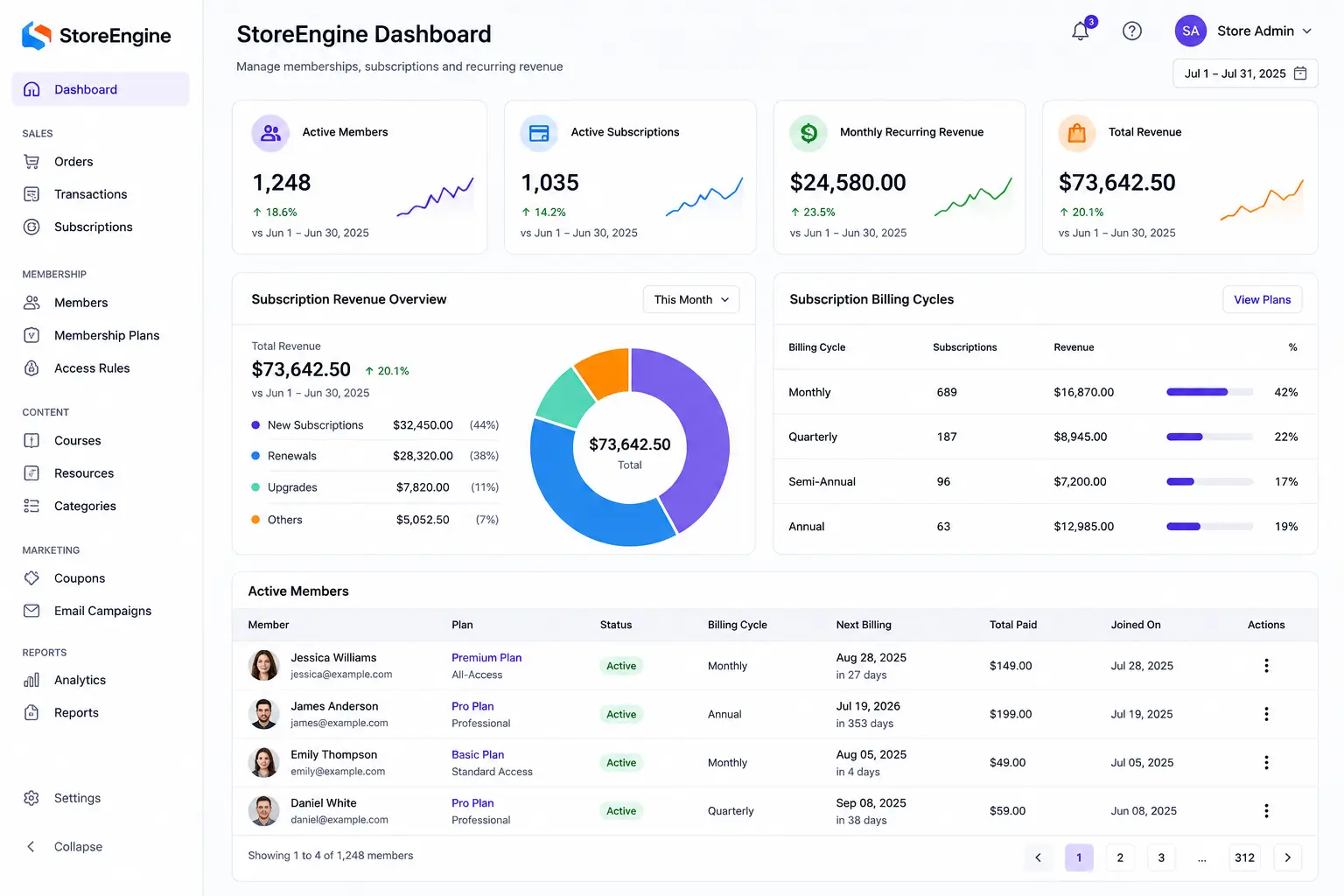
Here’s where most businesses hit a wall: the concept of layered membership and subscription models makes sense, but executing it requires billing automation, access control, member management, and community features — all working together, in real time.
That’s exactly what StoreEngine is built for.
StoreEngine is a WordPress-native eCommerce platform designed for businesses that want to move beyond simple product sales into recurring revenue — whether that means subscriptions, memberships, or a hybrid of both.
With StoreEngine, you can:
- Launch subscription products with automated recurring billing and flexible intervals
- Create membership tiers with exclusive pricing, early access, and gated content
- Run both models simultaneously with clean access control and automatic member management
- Handle installment payments, order bumps, and upsells built into your checkout flow
- Manage affiliate programs to grow both your subscription and membership bases
Most importantly, StoreEngine removes the need to stitch together five different plugins — a membership plugin here, a subscription plugin there, a billing gateway somewhere else. It’s a single, coherent system that handles the full recurring revenue stack.
For WordPress site owners who want to compete with the Shopify’s and WooCommerces of the world — while owning their platform completely — StoreEngine is the infrastructure that makes advanced pricing models actually work.
The Bottom Line
Membership vs subscription isn’t a debate about which model is “better.” It’s a question of what relationship you want to build with your customers.
Subscriptions are transactional by design — clean, scalable, and powerful for delivering consistent value. They’re the backbone of the SaaS economy for a reason.
Memberships are relational by design — sticky, identity-driven, and capable of building the kind of customer loyalty that no paid acquisition budget can replicate.
The businesses that win in 2026 and beyond aren’t choosing one over the other. They’re building both — a low-friction subscription entry point that graduates into a high-value membership experience.
If you’re running a WordPress business and you’re ready to build that kind of layered recurring revenue — without the technical headache of patching together multiple tools — StoreEngine gives you the infrastructure to do it right, from day one.
Your pricing model is your business model. Choose it intentionally.
Frequently Asked Questions
Is membership the same as subscription?
No — but they overlap. A subscription is a payment structure (recurring billing for access). A membership is a relationship structure (belonging, community, identity). Many memberships use subscription billing, but not all subscriptions are memberships.
Which is more profitable: membership or subscription?
Memberships tend to drive higher lifetime customer value and lower churn due to community attachment. Subscriptions win on volume and scalability. The most profitable businesses often run both — subscriptions for entry-level access, memberships for premium loyalty tiers.
Can a business have both membership and subscription?
Absolutely — and increasingly, the smartest businesses do. A subscription can be the base tier; membership unlocks additional community, perks, and identity. This stacked model maximizes both acquisition and retention.
What are examples of membership vs subscription?
Subscription: Netflix, Spotify, Adobe Creative Cloud. Membership: Thrive Market, Costco, gym memberships, professional associations. The line blurs when subscriptions add community features (which is exactly where the opportunity lies).
How do membership and subscription models work for WordPress businesses?
WordPress businesses can implement both using platforms like StoreEngine, which handles recurring billing, access control, member management, and checkout flows in a single plugin — no patchwork of tools required.