

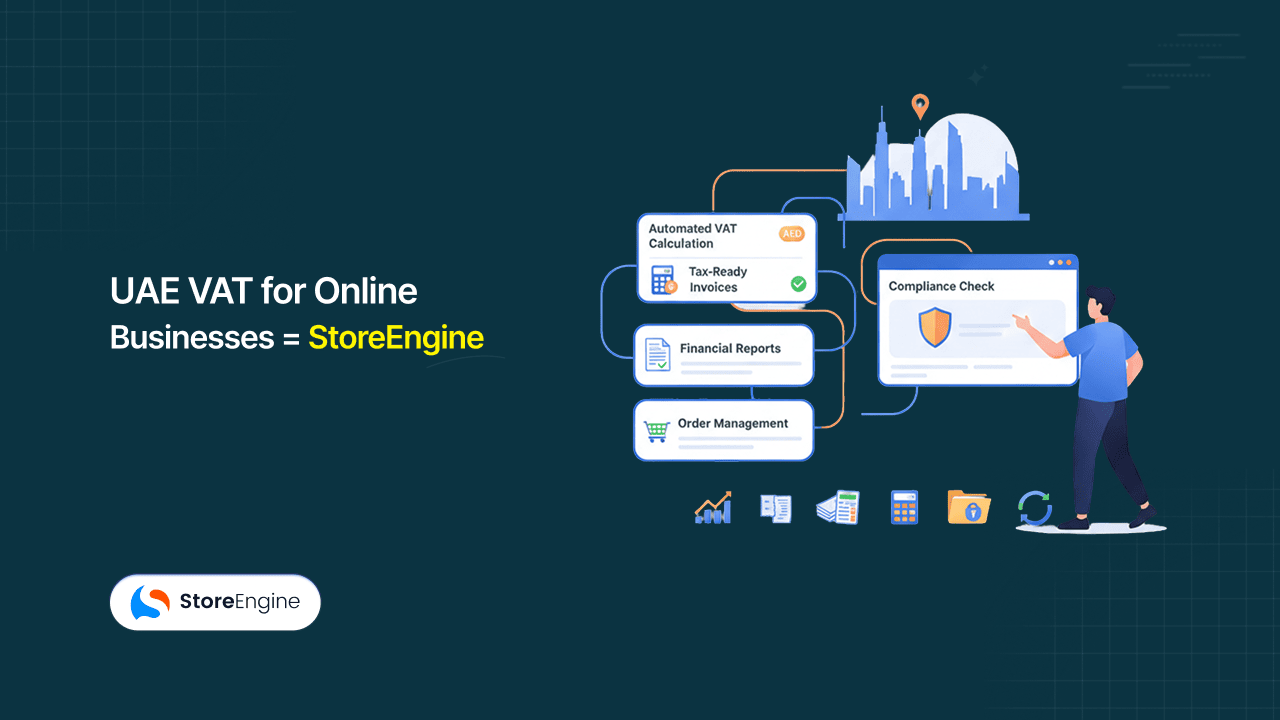

You’ve built a great online store. Orders are coming in. Customers from Dubai, Abu Dhabi, and across the UAE are buying your products. Business feels good.
Then someone mentions VAT.
Suddenly, the questions start. Do you need to register? Are you already non-compliant? What happens if you get it wrong?
The good news is that UAE VAT isn’t nearly as complicated as many online sellers think. But ignoring it can lead to penalties, compliance issues, and unnecessary headaches as your business grows.
This guide explains UAE VAT for online businesses in simple terms — including who needs to register, how the registration process works, what ongoing compliance looks like, and the common mistakes that can cost sellers money.
What Is UAE VAT for Online Businesses?
The UAE introduced Value Added Tax (VAT) on January 1, 2018, at a standard rate of 5%. Yes, just 5% — one of the lowest VAT rates in the world.
VAT is a consumption tax applied at each stage of the supply chain. As an online business owner, you collect VAT from your customers and pass it to the Federal Tax Authority (FTA) — the UAE’s official tax body.
For e-commerce, this means VAT applies to:
- Products sold to UAE customers
- Digital services delivered to UAE residents
- Subscription-based offerings accessed from the UAE
If you’re an international business selling to UAE customers, you’re not automatically exempt. The UAE’s tax rules extend to cross-border digital services and goods, which is exactly where many online sellers get caught off-guard.
Setting up your store correctly from day one saves a lot of pain later. StoreEngine is a WordPress eCommerce plugin built for selling physical, digital products, and subscription products — with built-in tax management and invoicing included from the start. No expensive add-ons needed. See all features →
Is VAT 5% in the UAE? Yes — But There Are Exceptions
The standard UAE VAT rate is 5%, and this applies to most taxable goods and services sold within the country.
However, not all transactions are taxed at the same rate. Some supplies qualify for a 0% VAT rate, while others are fully exempt from VAT.
|
Category |
VAT Rate |
|
Most goods and services |
5% |
|
Exports outside the UAE |
0% |
|
International transport |
0% |
|
Healthcare services |
0% |
|
Educational services |
0% |
|
Certain financial services |
Exempt |
|
Bare land sales |
Exempt |
For online businesses, exports are especially important. If you’re selling and shipping products outside the UAE, those transactions may qualify for zero-rated VAT. However, proper documentation and record-keeping are essential to support your tax treatment and remain compliant with FTA requirements.
Who Actually Has to Register for UAE VAT?

Not every online business is required to register for VAT, but understanding the thresholds is important.
Mandatory VAT registration applies when your taxable supplies and imports exceed AED 375,000 within 12 months.
Voluntary VAT registration is available for businesses with taxable supplies and imports exceeding AED 187,500, allowing them to recover VAT paid on eligible business expenses.
For international businesses selling goods or digital services to customers in the UAE, VAT obligations can still apply depending on the nature of the transactions and applicable registration requirements. If you’re unsure about your status, it’s always best to consult a qualified UAE tax professional.
Failing to register when required can result in penalties and additional compliance issues, making it important to monitor your revenue and registration thresholds as your business grows.
Do Freelancers Pay VAT in Dubai?
This is a common question among freelancers, and the answer depends on your annual taxable revenue.
Freelancers operating in Dubai under a freelance permit or as a sole proprietor are generally treated like any other business for VAT purposes. If your taxable supplies exceed AED 375,000 within a 12-month period, VAT registration becomes mandatory.
If your revenue is below that threshold, registration is optional. In some cases, voluntary registration can be beneficial because it allows you to recover VAT paid on eligible business expenses such as software subscriptions, hosting, and marketing services.
Whether you work in consulting, digital marketing, content creation, design, or other freelance services, the same VAT framework generally applies. Being a solo operator does not automatically exempt you from VAT obligations.
What Does UAE VAT Compliance Look Like Day-to-Day?

Once you’re registered for VAT, compliance becomes an ongoing part of running your business.
Most businesses file VAT returns quarterly through the FTA portal, reporting:
- Output VAT collected from customers
- Input VAT paid on business expenses
- The net VAT payable or refundable
You must also issue VAT-compliant invoices that include key details such as your Tax Registration Number (TRN), transaction date, VAT amount, and a description of the goods or services provided.
In addition, businesses are required to maintain accurate records and supporting documents for at least five years. Proper record-keeping helps ensure smooth VAT reporting and makes it easier to respond to audits or compliance reviews when necessary.
For online businesses, staying organized from the start can make VAT compliance significantly easier as your sales grow.
UAE VAT vs. Global VAT: How Does It Compare?
|
Aspect |
UAE |
EU |
UK |
USA |
|
Standard Rate |
5% |
17%–27% (varies by country) |
20% |
No federal VAT |
|
Registration Threshold |
AED 375,000 |
Varies by country |
£90,000 |
N/A |
|
Filing Frequency |
Quarterly |
Monthly/Quarterly |
Quarterly |
N/A |
|
Digital Services Tax |
Yes |
Yes (OSS) |
Yes |
State-level sales tax rules |
|
Penalty for Late Filing |
AED 1,000+ |
Varies |
Varies |
Varies |
Compared to many regions, the UAE maintains a relatively low VAT rate and a straightforward compliance framework, making it attractive for ecommerce businesses and international sellers.
Real Tools That Help You Stay Compliant

Managing VAT manually can quickly become overwhelming as your business grows. The right tools can make compliance much easier.
Accounting software:
- QuickBooks Online — UAE-specific VAT setup available
- Xero — VAT return preparation built in
- Zoho Books — strong UAE compliance module, FTA-integrated
E-commerce platform:
Your ecommerce platform plays a major role in VAT compliance. Tax calculations, invoice generation, and order records all need to be handled accurately from the point of sale.
StoreEngine is an all-in-one WordPress ecommerce plugin that includes built-in Tax Management and PDF Invoice generation to help support VAT compliance. It supports physical products, digital downloads, and subscription-based businesses, while offering multiple payment gateway integrations.
Because these features are included within the core platform, store owners can manage taxes and invoicing without relying on multiple third-party add-ons. Check the full comparison here →
FTA e-Services Portal:
The FTA e-Services Portal is the official platform for VAT registration, return filing, and tax payments. Any VAT-registered business in the UAE will need to use this portal to meet its compliance obligations.
Common Mistakes Online Businesses Make with UAE VAT
Even experienced online sellers can make VAT mistakes. Here are some of the most common ones:
Assuming VAT rules don’t apply to foreign businesses
Selling to UAE customers may create VAT obligations, even if your business is based outside the UAE.
Not charging VAT on digital products
Digital downloads, subscriptions, and SaaS products may also be subject to VAT requirements.
Poor record-keeping
Businesses should maintain accurate invoices and records to support VAT filings and compliance.
Missing filing deadlines
Late VAT returns can result in penalties and additional compliance issues.
Not reclaiming eligible input VAT
Many businesses miss opportunities to recover VAT paid on qualifying business expenses.
Pro tip: StoreEngine’s built-in PDF Invoice feature means every order automatically generates a downloadable invoice — helping you maintain a clear, organized record of transactions for VAT reporting and compliance. No additional invoicing plugin required. See StoreEngine pricing →
Future Outlook: UAE VAT in 2026 and Beyond

As the UAE’s tax framework continues to evolve, businesses can expect a greater focus on digital compliance, accurate reporting, and record-keeping.
The Federal Tax Authority (FTA) continues to enhance its digital systems, making it easier to identify reporting discrepancies and improve overall tax compliance. For online businesses, this means that maintaining accurate records and staying up to date with VAT requirements is becoming more important than ever.
The good news is that the UAE remains committed to maintaining a business-friendly tax environment, with its 5% VAT rate remaining one of the lowest in the region.
For growing ecommerce businesses, staying informed and building compliant processes early can help avoid future challenges as regulations continue to develop. For more ecommerce insights and practical selling strategies, the StoreEngine Blog provides resources designed for WordPress-based online businesses.
Final Word
UAE VAT doesn’t have to be complicated. Once you understand the requirements and put the right processes in place, compliance becomes a routine part of running your business.
The key is to stay proactive. Monitor your revenue, register when required, maintain accurate records, and use tools that simplify tax management and invoicing. Taking these steps early can help you avoid unnecessary penalties and compliance issues as your business grows.
If you’re building or scaling a WordPress ecommerce store, choosing a platform with built-in tax and invoicing capabilities can make day-to-day operations much easier. StoreEngine includes features such as Tax Management and PDF Invoice generation, helping online businesses manage sales and compliance more efficiently from a single platform.
Frequently Asked Questions
What happens if I don’t register?
Penalties for failure to register can reach AED 20,000. Additional fines apply for late filing and unpaid VAT.
Do freelancers pay VAT in Dubai?
Yes. Freelancers are generally subject to the same VAT rules as other businesses. If annual taxable supplies exceed AED 375,000, VAT registration is mandatory. Below that threshold, voluntary registration may be available.
Who is subject to the 12% VAT?
The UAE does not have a 12% VAT rate. The standard UAE VAT rate is 5%. The 12% VAT rate is used in some other countries, such as the Philippines.
Can I register for UAE VAT as a foreign business?
Yes. Depending on the nature of its activities and taxable supplies in the UAE, a foreign business may be required to register for VAT and comply with applicable FTA requirements.