

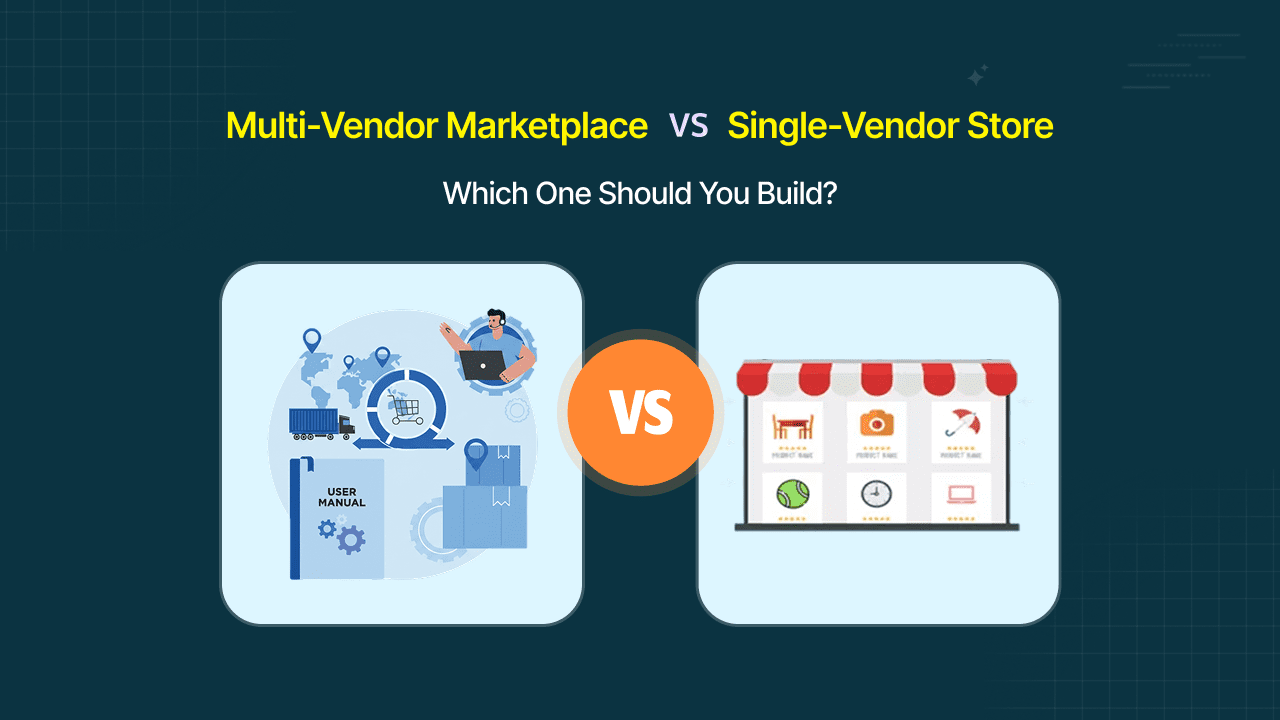

Every online business eventually faces a fork in the road: do you sell your own products as a single-vendor store, or do you build a multi-vendor marketplace where many sellers list their products under one roof? It’s not just a technical decision — it shapes your revenue model, your daily workload, your risk, and how far you can scale.
Amazon, Etsy, and eBay are marketplaces. Allbirds, Gymshark, and your neighborhood Shopify boutique are single-vendor stores. Both models make money. But they make money in completely different ways, and the wrong choice can cost you years of effort building the wrong infrastructure.
This guide breaks down the real differences — control, cost, revenue, scalability, and operational complexity — so you can choose with clarity. And because the platform you build on determines how painful (or painless) that choice is, we’ll show how StoreEngine lets you run either model, and switch between them, without replatforming.
The Core Difference in One Picture
Before diving into the details, here’s the fundamental split between the two models side by side.

Single-vendor vs multi-vendor: who owns the inventory, who sets prices, and who keeps the money
In a single-vendor store, you are the only seller. You buy or make the products, set the prices, hold the inventory, fulfill every order, and keep all the revenue. In a multi-vendor marketplace, independent vendors do most of that work — they list their own products, manage their own stock, and ship their own orders. You provide the platform and take a commission on every sale.
What Is a Single-Vendor Store?
A single-vendor store is the classic eCommerce setup: one business selling its own catalog. You have complete control over everything the customer sees and experiences, from product photography to packaging to the refund policy.
Advantages of a Single-Vendor Store
- Total brand control. Every product, price, image, and message is yours. Nothing dilutes your brand identity.
- Simpler operations. One inventory system, one fulfillment process, one set of numbers to track. There are no vendors to approve, pay, or moderate.
- You keep 100% of revenue. There’s no commission split. Every dollar of margin is yours (minus your own costs).
- Faster to launch. You don’t need to recruit sellers before you have anything to sell. You can go live the day your products are ready.
- Higher margins per sale. Because you own the product, you capture the full markup rather than a slice of someone else’s.
Disadvantages of a Single-Vendor Store
- Growth is capped by your capacity. Every new product means you sourcing, storing, and shipping it. Scaling the catalog means scaling your own operations.
- All the risk is yours. Unsold inventory, supplier problems, and demand swings all land on you alone.
- Limited selection. Customers see only what you choose to stock, which can lose you sales to broader competitors.
What Is a Multi-Vendor Marketplace?
A multi-vendor marketplace is a platform where many independent sellers list their products together. You don’t own most of the inventory — you own the destination. Think of it as building the mall rather than a single shop inside it.
Advantages of a Multi-Vendor Marketplace
- Scales without you buying stock. Your catalog grows every time a new vendor joins — and you never paid for that inventory. The marketplace can offer thousands of products you never had to source.
- Commission revenue on autopilot. You earn a cut of every sale across every vendor, without touching the product yourself.
- Risk is distributed. If one vendor’s products don’t sell, it’s largely their loss, not yours. Your risk is spread across the whole roster.
- Network effects. More sellers attract more buyers, and more buyers attract more sellers — a flywheel a single store can’t replicate.
Disadvantages of a Multi-Vendor Marketplace
- More complexity to manage. You’re now running vendor approvals, commission payouts, product moderation, and dispute handling on top of a normal store.
- Lower margin per sale. You earn a commission (often 5–20%), not the full markup.
- Quality control is harder. Many sellers means varying product quality, shipping speed, and customer service — all of which reflect on your brand.
- The chicken-and-egg problem. You need sellers to attract buyers, but sellers won’t join without buyers. Getting the flywheel spinning is the hardest part.
How the Money Actually Works in a Marketplace
The commission model is what makes a marketplace tick, and it’s worth understanding clearly. When a customer buys from a vendor on your marketplace, a single payment comes in — and the platform automatically splits it between you and the seller.

One customer payment is automatically split into your commission and the vendor’s balance
Say a customer pays $100 for a vendor’s product and your commission rate is 10%. The marketplace records a $10 commission for you and credits $90 to the vendor’s balance. The vendor later withdraws their balance to PayPal or a bank account. Crucially, good marketplace software calculates this at the moment of payment, so a later rate change never rewrites past orders.
This is fundamentally different from a single store, where the entire $100 (minus your product cost) is simply yours. The marketplace trades margin-per-sale for volume and scale.
Side-by-Side: The Decision Factors That Matter
Here’s how the two models compare on the factors that will actually affect your business day to day.
|
Factor |
Single-Vendor Store |
Multi-Vendor Marketplace |
|
Who owns inventory |
You |
Each vendor |
|
Revenue model |
Full product margin |
Commission per sale |
|
Startup speed |
Fast |
Slower (need sellers) |
|
Operational load |
Low–medium |
High |
|
Brand control |
Complete |
Shared |
|
Scalability |
Limited by you |
Very high |
|
Risk |
All yours |
Spread out |
|
Best for |
Focused brands |
Wide selection, scale |
Which Model Is Right for You?
There’s no universally correct answer — only the right answer for your goals, resources, and appetite for complexity. Use this quick decision guide as a starting point.

A simple decision guide — and a reminder that you can start with one model and add the other later
Choose a single-vendor store if you have your own products, want full control of brand and margin, and prefer simpler operations. It’s the right call for focused brands, niche products, and anyone who wants to launch quickly.
Choose a multi-vendor marketplace if your goal is breadth of selection and scale, you’d rather earn commission than hold inventory, and you’re prepared to handle the extra operational complexity of managing sellers. It suits aggregators, community marketplaces, and category-defining platforms.
You Don’t Have to Choose Forever
Here’s the part most comparison articles miss: this isn’t a permanent, one-way decision — if you build on the right platform. Many of the most successful marketplaces started as single stores, proved demand, and then opened up to third-party sellers once they had traffic.
This is exactly where StoreEngine stands apart. StoreEngine is an all-in-one WordPress eCommerce platform that runs a polished single-vendor store out of the box — and turns into a full marketplace the moment you switch on the Multi-Vendor add-on. No replatforming. No data migration. No starting over.
Building Either Model with StoreEngine
Because StoreEngine is built as a modular, add-on-based platform, you turn capabilities on as you need them. That makes it uniquely suited to both models — and the journey between them.
As a Single-Vendor Store
Out of the box, StoreEngine gives you everything a focused brand needs: product and inventory management, a fast checkout (including one-click Instant Checkout), built-in payments via PayPal and Stripe, subscriptions, coupons, dynamic pricing, and advanced analytics — all in one dashboard, with no monthly transaction fees.
As a Multi-Vendor Marketplace
Switch on the Multi-Vendor add-on and your store becomes a marketplace. Vendors get their own front-end dashboards to manage products, orders, inventory, and returns — they never touch your WordPress admin. You set a commission rate (a global default, or per-vendor overrides), approve or suspend sellers, control which products go live, and manage payouts. Each vendor gets a public store page, and you can award trust badges like Verified or Top Rated.
The commission engine handles the money split automatically, reverses commission on refunds to keep balances accurate, and (on Pro) adds per-vendor analytics and admin-recorded payouts. A single customer order can contain products from several vendors, with each seller fulfilling only their own items.
| The key advantage: you can launch as a single store today, validate your market, and flip on multi-vendor capabilities when you’re ready to scale — all on the same platform, with the same data, the same theme, and the same customers. |
Frequently Asked Questions
What is the main difference between a single-vendor and multi-vendor store?
In a single-vendor store, one business sells its own products and keeps all revenue. In a multi-vendor marketplace, many independent sellers list their products and the platform owner earns a commission on each sale instead of owning the inventory.
Is a marketplace more profitable than a single store?
Not necessarily. A marketplace earns a smaller cut per sale (commission) but can scale to far more sales without buying inventory. A single store earns full margin per sale but is limited by how much you can stock and ship yourself. Profitability depends on volume, margins, and operational efficiency.
Can I start as a single store and become a marketplace later?
Yes — if your platform supports it. With StoreEngine, you can run a single-vendor store and later enable the Multi-Vendor add-on to add sellers, without migrating to a new platform or losing your existing products, orders, or customers.
How does commission work in a multi-vendor marketplace?
When a customer pays, the platform automatically splits the payment: your commission goes to you and the remainder is credited to the vendor’s balance, which they withdraw later. Commission is calculated at the time of payment, so later rate changes don’t affect past orders.
Which model is easier to start?
A single-vendor store is faster and simpler to launch because you don’t need to recruit sellers first. A marketplace requires building a base of vendors before it becomes useful to buyers, which takes more time and effort upfront.
The Bottom Line
The choice between a multi-vendor marketplace and a single-vendor store comes down to control versus scale. A single store gives you full ownership, simpler operations, and higher margins per sale — ideal for focused brands. A marketplace trades some control and per-sale margin for the ability to scale a vast catalog on commission, without owning the inventory.
Most businesses are better off starting focused: launch a single-vendor store, prove there’s demand, and build an audience. Then, when you’re ready to scale beyond your own catalog, open the doors to vendors.
The smartest move is to build on a platform that doesn’t force the decision on day one. With StoreEngine, you can start simple and grow into a marketplace on your own timeline — one platform, both models, no rebuild required.