

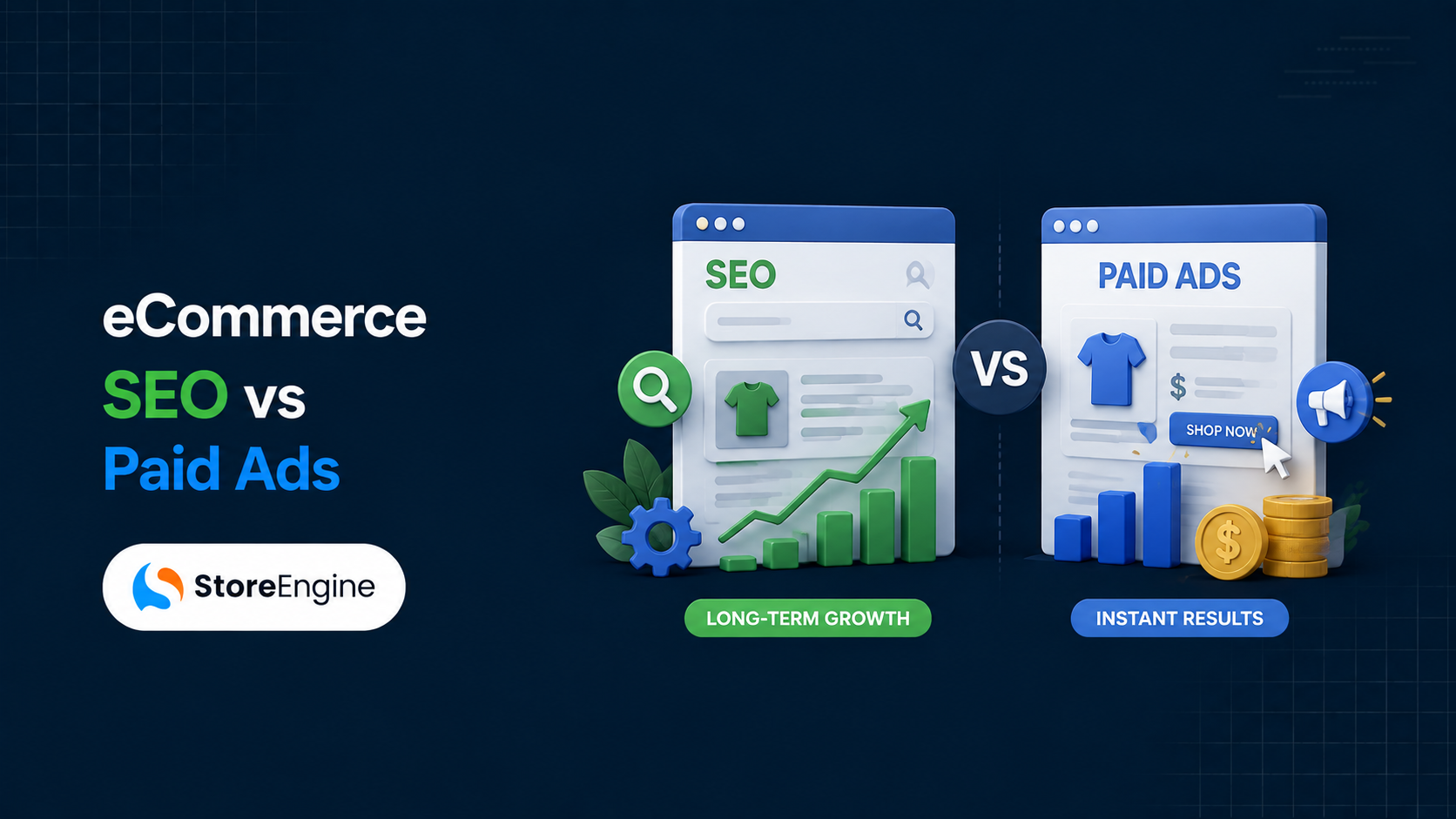

If you are starting an online store with limited budget, begin with SEO. If you need sales in the next 30 days, start with paid ads. The honest answer for most eCommerce businesses in 2026 is both — but in a specific sequence. SEO delivers 748% average long-term ROI and costs 84% less per lead than paid channels, but takes 4 to 12 months to compound. Paid ads deliver results in days, but stop the moment your budget does.
💡 Quick Takeaway:
SEO overtakes paid ads in ROI somewhere between months 9 and 12. Before that crossover point, paid ads typically win on speed. The stores that grow fastest use paid ads to generate early revenue while building SEO in parallel — so that organic traffic progressively reduces their cost of acquisition over time.
Why is choosing between SEO and paid ads so difficult?
Because they solve different problems on different timelines. Most advice online frames this as a competition when it is actually a sequencing question. Paid ads solve the immediate revenue problem. SEO solves the long-term cost-of-acquisition problem. Running only one and ignoring the other is almost always a mistake — the real question is where to put your first dollar given your current situation.
The 2026 data makes this clearer than ever. Organic search drives 53% of all web traffic, while paid search accounts for 23.6% of eCommerce traffic. SEO leads close at 14.6%, compared to 3.75% for PPC. The average cost per lead from SEO is $31, versus $198 from paid channels. But PPC can generate ROI in as little as 30 days, and Google Shopping ads average a 4.6x return on ad spend — meaning every dollar spent returns $4.60 in revenue.
Both channels work. Neither works in isolation. The decision is about which one to fund first given your budget, your timeline, and the competitive landscape of your specific niche.
What are the real strengths of eCommerce SEO?
Traffic that compounds over time
The defining characteristic of SEO is that content published today continues earning traffic for years. A product category page that ranks on page one for “best wireless earbuds under $100” keeps sending buyers without any ongoing cost-per-click. Businesses investing in long-term SEO strategies report average returns of up to 748%, and 91% of marketers who invested in SEO in 2026 reported positive ROI.
This compounding effect is what makes SEO the highest-ROI channel over time. Organic search also converts at 2.4% on average — nearly double the 1.3% average for PPC — because organic visitors trust a result they found rather than one served to them as an ad.
Lower cost per acquisition at scale
Paid ads have a predictable math problem: as you scale, your cost-per-click rises because you are bidding against more competitors for the same inventory. SEO has the opposite dynamic. As your domain authority grows, new content ranks faster and with less effort. The cost per lead from organic search averages $31, versus $198 for paid channels — an 84% cost advantage that widens as organic authority compounds.
The AI search opportunity in 2026
In 2026, a new dynamic has emerged. AI search engines — ChatGPT, Perplexity, Google AI Overviews — are now answering buying questions directly in the search interface, reducing clicks to traditional organic results. This creates a new SEO surface: being cited by AI as a trusted source. Stores that publish genuinely useful, authoritative content are now appearing in AI-generated answers, which generates branded awareness even when the user never visits the site. Only 14% of marketers currently track AI search visibility alongside traditional SEO — making it an early-mover advantage for stores willing to optimize for it now.
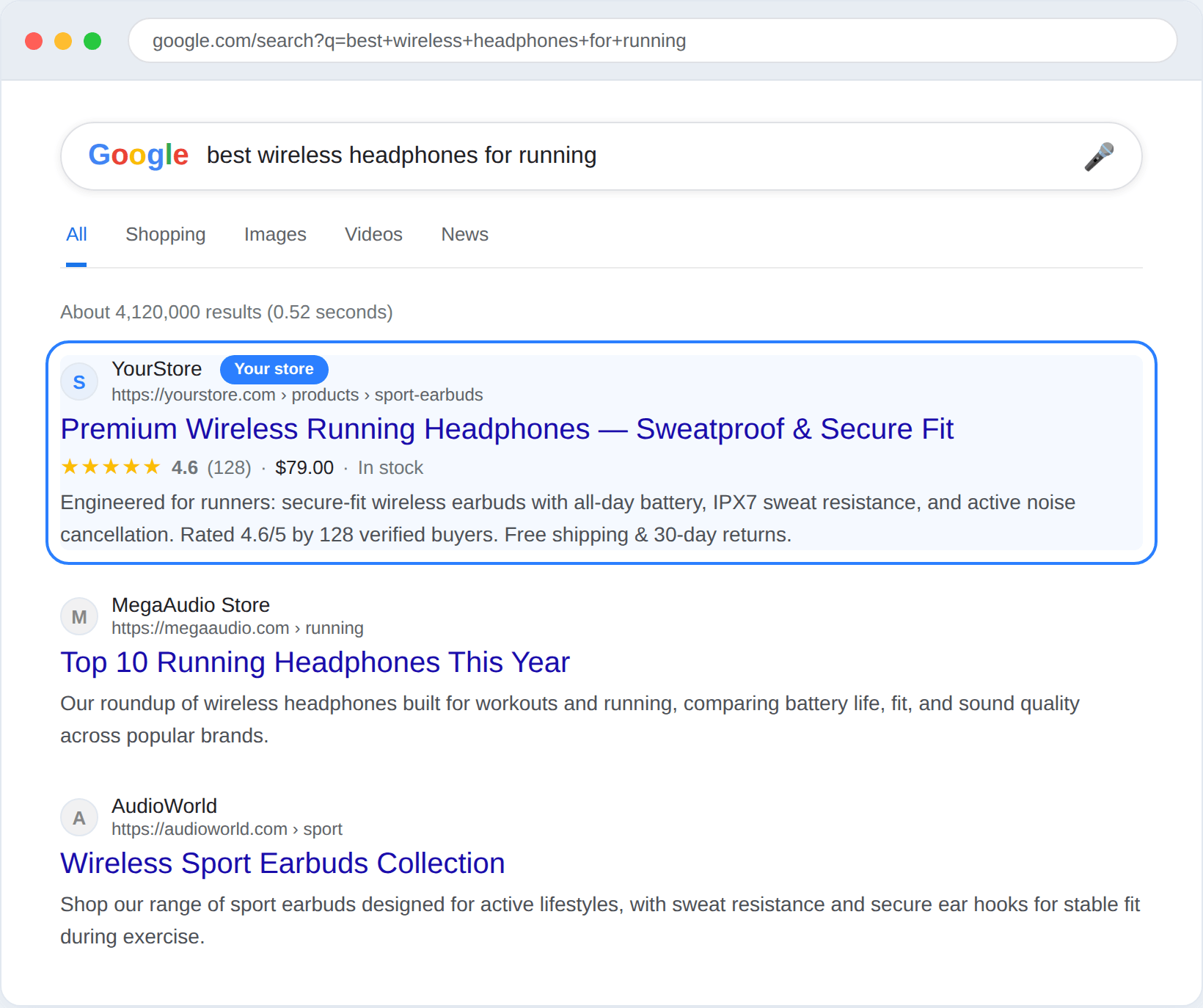
What are the real strengths of paid ads for eCommerce?
Immediate, controllable traffic
Paid ads are the only channel where you can turn traffic on and off in hours. Set up a Google Shopping campaign today and your products can appear in search results by tomorrow. For new stores that need early validation — does this product sell? does this audience convert? — paid ads answer those questions in days, not months. PPC can generate measurable ROI in as little as 30 days, which is why it is almost always the right starting point when you need revenue fast.
Precision targeting
Paid ads let you define your audience by search intent, demographics, interests, lookalike behavior, and retargeting. You can show ads exclusively to people who searched for exactly your product category, or retarget visitors who looked at a specific product page but did not buy. 65% of all high-intent searches result in a paid ad click — meaning PPC captures a significant share of ready-to-buy shoppers before any organic result gets the chance.
Testing and data generation
Perhaps the most underrated use of paid ads for new stores is not direct revenue — it is data. Paid traffic tells you which product pages convert, which price points work, which headlines get clicked, and which audiences actually buy. This data is worth its cost even if the campaign breaks even, because it informs every SEO and organic content decision you make afterward.
How do SEO and Paid Ads compare directly?
A head-to-head breakdown of the two biggest eCommerce traffic channels — by cost, speed, ROI, and long-term value.
|
eCommerce SEO Long-term |
Paid Ads (PPC / Shopping) Short-term |
|
|
Time to first results |
4–12 months |
Days to weeks |
|
Average cost per lead |
$31 |
$198 |
|
Lead close rate |
14.6% |
3.75% |
|
Average conversion rate |
2.4% |
1.3–1.9% |
|
Traffic when budget stops |
✓ Continues |
✗ Stops immediately |
|
Long-term ROI (12+ months) |
748% average |
36% average |
|
Short-term ROI (0–6 months) |
Low / building |
High (4.6x ROAS) |
|
Best for |
Sustainable growth |
Fast validation & scale |
The verdict: SEO wins on long-term ROI, lead quality, and cost per acquisition. Paid ads win on speed and immediate validation. The stores that grow fastest use both — paid ads for early revenue, SEO for compounding returns over time.
Where should you actually start?
The honest answer depends on three variables: your budget, your timeline, and your domain authority today. Here is the decision framework most eCommerce stores should follow.
Start with paid ads if:
In this scenario, use paid ads to generate early revenue and data. Simultaneously, begin building your SEO foundation — product page optimization, blog content, internal linking — so that organic traffic starts building in the background while your paid campaigns fund operations.
Start with SEO if:
In this scenario, build content around buyer-intent keywords (product comparisons, how-to guides, best-X-for-Y posts), optimize product category pages for target terms, and invest in internal linking across your blog and product pages. Introduce paid ads once SEO starts delivering traffic, using ads to amplify what is already working rather than carry the full acquisition load.
The combined approach (recommended for most stores):
Run paid ads from day one to generate revenue and gather conversion data. Use that data to identify which product pages and audiences actually convert. Then invest SEO effort into those exact pages and topics — ranking organically for what you already know converts from paid. Over 9 to 12 months, as organic traffic grows, you can reduce paid spend on the terms where you now rank organically, lowering your cost of acquisition while maintaining total traffic volume.
How StoreEngine supports both channels from one platform
Running SEO and paid ads in parallel is only sustainable when your store gives you accurate conversion data and a technically sound foundation for both. This is where the store platform matters more than most people realize.
The Bottom Line
The SEO vs paid ads debate is mostly a distraction. Both channels work. The real question is which one solves your most pressing problem right now — and whether your store is technically ready to convert the traffic either channel sends. Fix your checkout, set up conversion tracking, and then choose the channel that fits your timeline. Most stores that scale sustainably start with paid ads for speed, build SEO for compounding returns, and let the two reinforce each other over time.
Frequently asked questions
How long does it take for eCommerce SEO to show results?
Most eCommerce SEO campaigns take 4 to 12 months to produce meaningful organic traffic, depending on domain authority, content quality, and keyword competition. Technical SEO alone (fixing site structure, speed, and schema markup) can return 117% ROI within 6 months on established sites. New domains typically see their first significant organic rankings between months 6 and 9.
Is paid advertising worth it for a new online store with a small budget?
Yes, but the goal should be data, not profit. A small paid budget ($200-500/month) on Google Shopping or Meta ads tells you which products and audiences actually convert, which is information worth paying for. Use that data to prioritize your SEO content and product page optimization. Once your organic traffic grows, you can reduce paid spend on the keywords where you now rank for free.
Does AI search (ChatGPT, Perplexity) change the SEO vs ads calculation?
Yes, in two ways. First, AI Overviews in Google can reduce click-through rates on organic position-one results by up to 58-61%, which somewhat reduces the traffic value of top organic rankings. Second, AI answer engines create a new citation opportunity — stores with genuinely useful, authoritative content are being cited in AI-generated answers, generating brand visibility even without a click. This makes content quality more important than ever, and makes AI search a new surface worth optimizing for alongside traditional SEO.
Which channel has a better conversion rate — SEO or PPC?
SEO converts at 2.4% on average, compared to 1.3 to 1.9% for PPC. The difference comes from trust and intent: organic visitors found your result without being served an ad, which increases credibility. However, PPC can target very high-intent queries (someone searching “buy [product] now”) where conversion rates exceed organic averages. The most accurate answer is: both channels can convert well, and the quality of your product page and checkout matters more than the traffic source at the moment of decision.