


You built a solid online store. Orders are rolling in. And then someone from Germany buys your product — and you realize you have no idea how VAT works, which currency to charge, or whether your payment gateway even processes euros.
That’s the moment cross-border ecommerce stops being a dream and starts being a very real operational puzzle. One you either solve deliberately — or stumble through expensively.
Here’s the truth: a founder with a well-differentiated product can now be selling in 10 countries within 90 days of making that decision. The infrastructure exists. The global demand is there. You just need the right setup — and the right platform to run it all on without duct-taping seven different plugins together.
This guide covers everything: what cross-border ecommerce actually involves, how taxes, multi-currency pricing, and payments work in practice, the most common mistakes sellers make, and how StoreEngine makes all of it manageable from WordPress.
What Is Cross-Border eCommerce?
Cross-border ecommerce is selling products or services online to customers in other countries — operating across different tax jurisdictions, currencies, regulatory environments, and payment systems all at once.
It sounds complex. And it is, if you build your store without thinking internationally from the start. But for sellers who approach it properly, it’s one of the biggest revenue opportunities in digital commerce right now.
The global cross-border B2C ecommerce market was valued at USD 1,505.49 billion in 2024, and is projected to reach USD 9,956.11 billion by 2033 at a CAGR of 21.02%.
About 59% of global shoppers now purchase from retailers outside their own country, and 35% do so at least monthly.
Cross-border ecommerce is also expanding 28.3% faster than domestic ecommerce through 2030.
The opportunity is not on the horizon anymore. It’s here. And the sellers who solve the operational complexity now are the ones who will own the market later.
The 3 Pillars of Cross-Border eCommerce
Every successful international ecommerce business rests on three foundations:
- Tax & Customs Compliance — knowing exactly what you owe, where, and when
- Multi-Currency Pricing — letting customers pay in their own money without friction
- Cross-Border Payment Gateways — actually collecting that money in the way each market expects
Underestimate any one of these and you’re either hemorrhaging customers at checkout or sitting on a tax liability you didn’t know you’d built up.
Before you even reach those three pillars, there’s one thing that underpins all of it: discoverability. If international buyers can’t find your store organically in their market, none of the operational setup below matters. Your eCommerce SEO strategy has to come first — ranking in multiple markets requires localized content, hreflang tags, and technical SEO built for global traffic from day one.
With that in place, let’s go through each pillar.
Pillar 1: Tax & Customs Compliance for International Selling
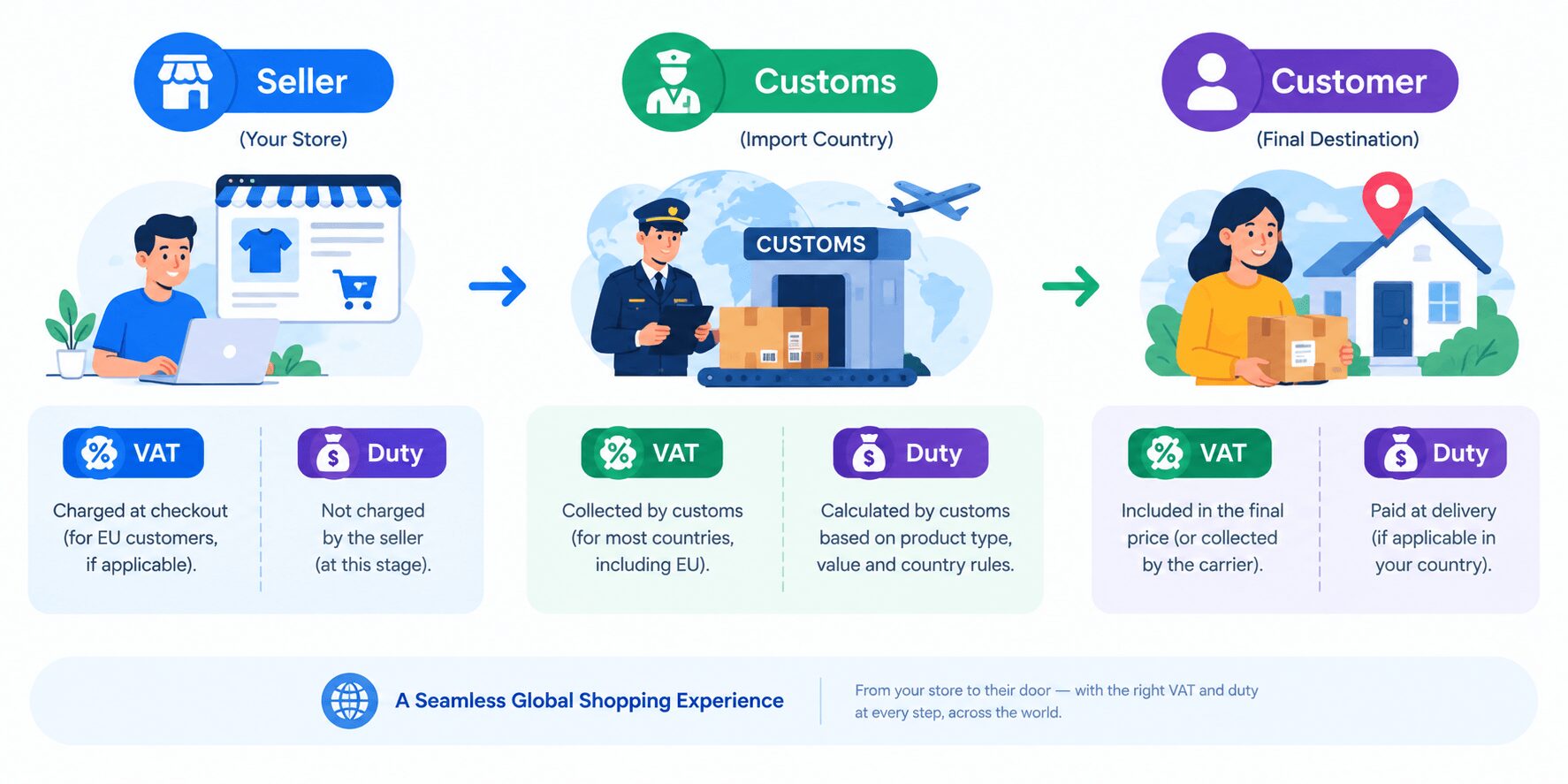
This is where first-time global sellers most often get burned. The rules differ radically by market, they change frequently, and the penalties for non-compliance range from delayed shipments to full account suspensions on major platforms.
EU VAT: What Changed in 2026
If you’re selling to European customers, two mechanisms govern your VAT obligations:
The Import One-Stop Shop (IOSS) simplifies compliance for imports valued at €150 or less. Instead of registering for VAT in every EU country where you have customers, you register once in a single Member State and file a single monthly return covering your entire EU VAT liability. When using IOSS, you collect VAT at the customer’s local rate at checkout — 20% in France, 19% in Germany, 23% in Ireland — and remit it monthly.
The One-Stop Shop (OSS) applies to goods above €150 and digital services. Once your cross-border B2C sales exceed €10,000 across the EU, the place of supply shifts to the customer’s country, and you must charge that country’s VAT rate.
Critically: the €150 customs duty exemption ended on 1 July 2026, replaced by a transitional €3 flat duty per item on every low-value shipment entering the EU.
What this means for sellers:
- Every parcel now carries a per-item cost regardless of product value
- Non-EU sellers must appoint an EU-based fiscal intermediary to use IOSS
- Failing to collect VAT at checkout means your customer gets hit with unexpected charges at delivery — and returns it
US Rules: The De Minimis Exemption Is Gone
Under Executive Order 14256 signed in August 2025, parcels under US$800 shipped from China and Hong Kong no longer enter the United States duty-free. They now face applicable Section 301 tariffs plus a per-parcel carrier handling fee of US$80–US$200.
If your supply chain relies on direct-to-consumer shipping from China, the landed cost math has fundamentally changed. A product that cost $0 in duties six months ago now costs $30+ to clear. Re-routing through a US 3PL or bonded warehouse is no longer optional for sellers in this situation — it’s survival.
UK, Australia, and Other Key Markets
The UK charges VAT from your very first sale to a UK customer, with no minimum threshold for overseas sellers. VAT applies to imports under £135 at the point of sale — meaning you collect it at checkout and remit it to HMRC. Imports over £135 face VAT and customs duty at the border.
Australia applies GST to all imports, with no de minimis exemption. If you’re selling to Australian customers, you register for GST, collect 10% at checkout, and remit quarterly.
Tax Compliance at a Glance
|
Market |
Tax Type |
Threshold |
2026 Change |
|
European Union |
VAT (IOSS / OSS) |
€150 / €10,000 |
€3 flat duty per shipment from July 2026 |
|
United States |
State Sales Tax |
Varies by state |
De minimis ended for China/HK shipments |
|
United Kingdom |
VAT |
No threshold (overseas sellers) |
Collect at checkout from first sale |
|
Australia |
GST |
No threshold (overseas sellers) |
10% on all goods |
|
Canada |
GST/HST |
CAD 30,000 |
Province-specific rates apply |
Pillar 2: Multi-Currency Pricing
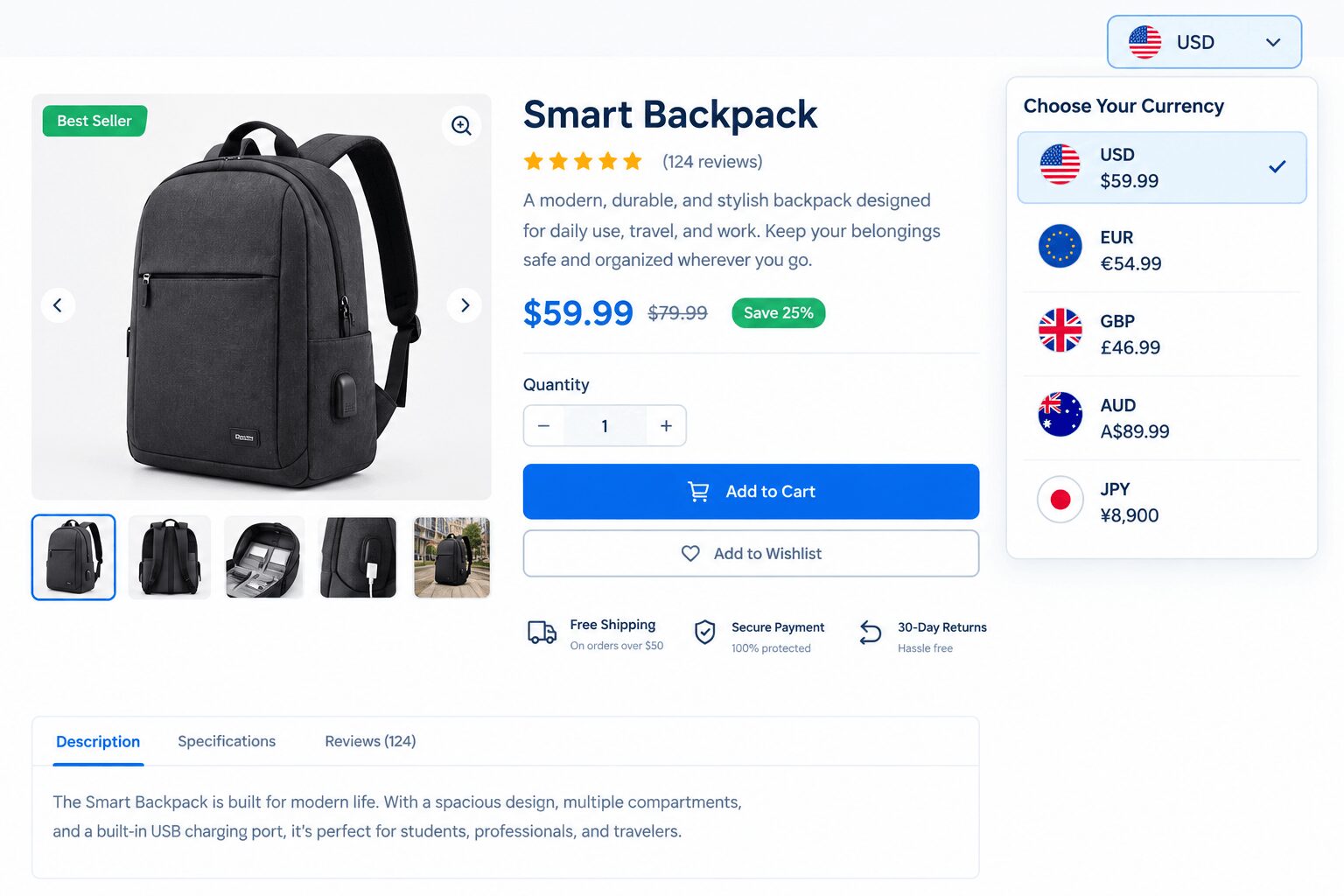
Here’s the conversion truth most store owners discover too late: customers buy more when they see prices in their own currency. Not because they can’t do the math — but because unfamiliar currency formatting creates unconscious friction. “Is $89 a lot? Let me think…” Thinking is the enemy of buying.
When you display €82.50 to a French buyer, there’s nothing to think about. They know whether it’s reasonable. That moment of certainty is where the sale happens.
Offering “Credit Card” or “PayPal” as your only payment options can lock out 40–60% of buyers in emerging markets who don’t use international credit cards.
What a Proper Multi-Currency Setup Actually Requires
This isn’t just slapping a currency converter widget on your product page. A real multi-currency setup needs:
- Real-time currency conversion — prices reflect live exchange rates, not rates from last Tuesday
- Geo-based display — visitors automatically see their local currency based on their location
- Settlement in your home currency — you receive clean payouts in your base currency regardless of what the customer paid in
- Tax-inclusive pricing by market — EU and UK buyers expect to see VAT already included in the displayed price, not added at checkout
- Currency-specific rounding rules — €9.99 looks professional; €9.87 looks like a bug
StoreEngine handles all of this natively. Its built-in international selling capabilities support 130+ currencies, auto-convert at live rates, apply geo-detection without additional plugins, and settle payments in your preferred currency.
For a complete walkthrough of the currency setup, the dedicated guide Multi Currency WordPress: How to Sell in Multiple Currencies covers every configuration step in detail.
How Platforms Compare on Multi-Currency
|
Platform |
Multi-Currency |
Geo-Detection |
Extra Cost |
|
StoreEngine |
Built-in |
Yes |
Included in plan |
|
WooCommerce |
Plugin required |
Plugin only |
$49–$149/yr |
|
Shopify |
Markets (paid plans) |
Yes |
Higher tier required |
|
BigCommerce |
Native |
Yes |
All plans |
Pillar 3: Cross-Border Payment Gateways
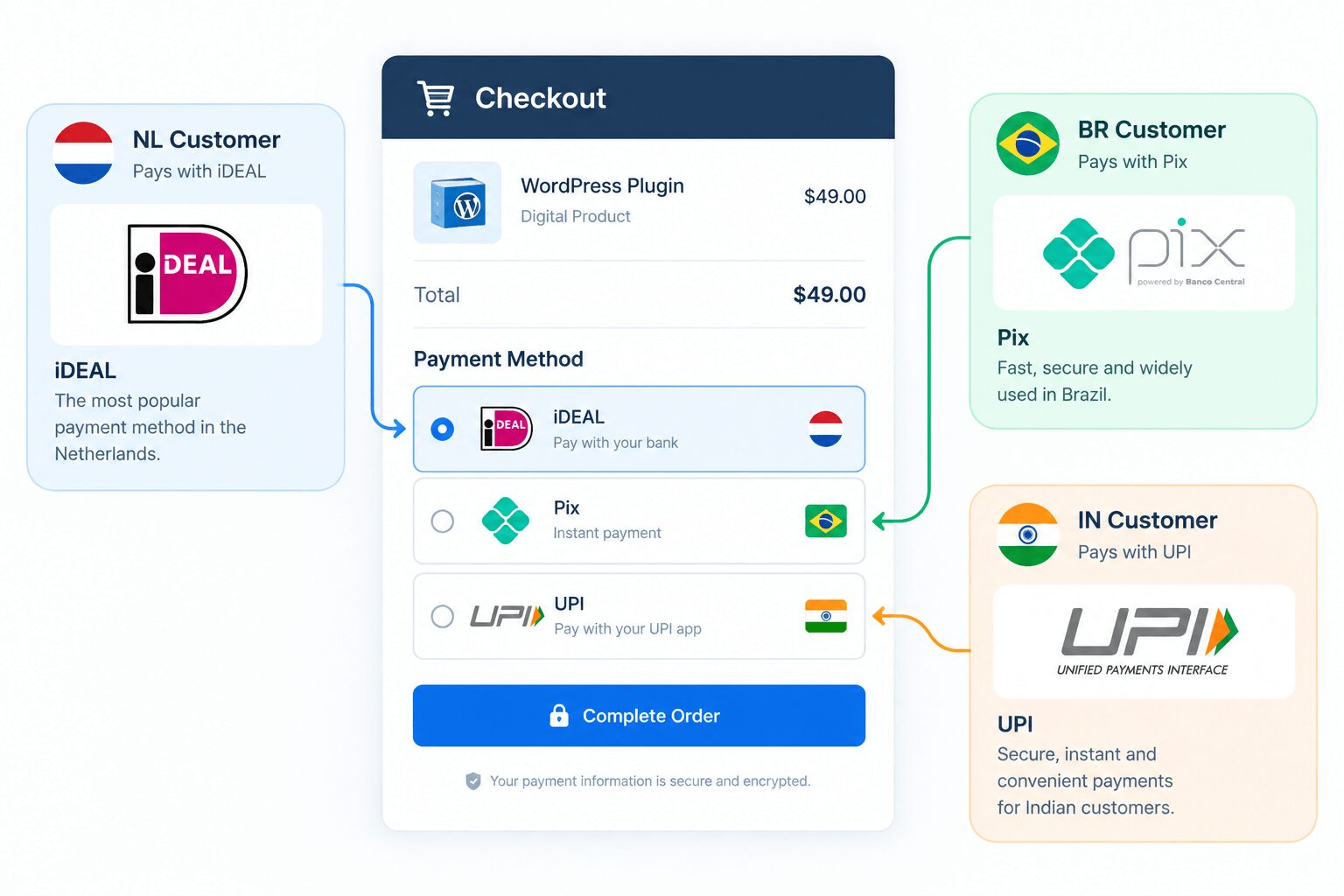
This is the operational layer most sellers think they’ve solved when they turn on PayPal. They haven’t.
Payment preferences vary enormously by market — and offering the wrong payment method at checkout is functionally the same as not offering the product at all. A German buyer who wants to pay via Sofort will not enter their credit card number. A Brazilian customer expecting Pix will not use PayPal. These aren’t preferences — they’re non-negotiables in their respective markets.
Local Payment Methods by Region
|
Region |
Expected Payment Methods |
|
United States |
Credit/debit card, PayPal, Apple Pay, Google Pay |
|
Germany |
Sofort, Klarna, SEPA Direct Debit, PayPal |
|
Netherlands |
iDEAL, Klarna, credit card |
|
France |
Carte Bancaire, PayPal, Klarna |
|
Brazil |
Pix, Boleto Bancário, local credit installments |
|
India |
UPI, Netbanking, Paytm, Rupay |
|
Southeast Asia |
GrabPay, GCash (PH), Dana (ID), OVO (ID), PromptPay (TH) |
|
Middle East |
Local cards, cash-on-delivery, KNET (Kuwait) |
If you’re prioritizing European expansion, the full breakdown of payment gateways for global sales and the best payment gateways in Germany specifically are worth reading before you configure your checkout.
StoreEngine’s enterprise payment solutions for WordPress integrate Stripe, PayPal, and regional gateways through one unified setup — so the right payment method surfaces automatically based on the customer’s location.
Checkout Architecture Matters as Much as Payment Methods
Even with the right payment options available, a clunky checkout flow kills international conversions. International buyers have less patience for multi-step checkout than domestic ones — every additional page is a new opportunity to abandon.
There are three checkout models worth understanding for global stores:
- One-page checkout — everything on a single screen, dramatically reduces friction. See how one-page checkout for WordPress performs versus traditional flows.
- Instant checkout — skip the cart entirely, go straight to payment. WordPress instant checkout is ideal for single-product offers and international landing pages.
- Embeddable checkout — embed the full checkout experience directly into any page or landing page without redirecting to a separate checkout URL. Embeddable checkout is particularly effective for international paid traffic campaigns.
And if you haven’t already set up PayPal specifically — which remains the most recognized payment method globally for cross-border purchases — that’s a quick win worth prioritizing.
How to Start Cross-Border eCommerce: Step-by-Step
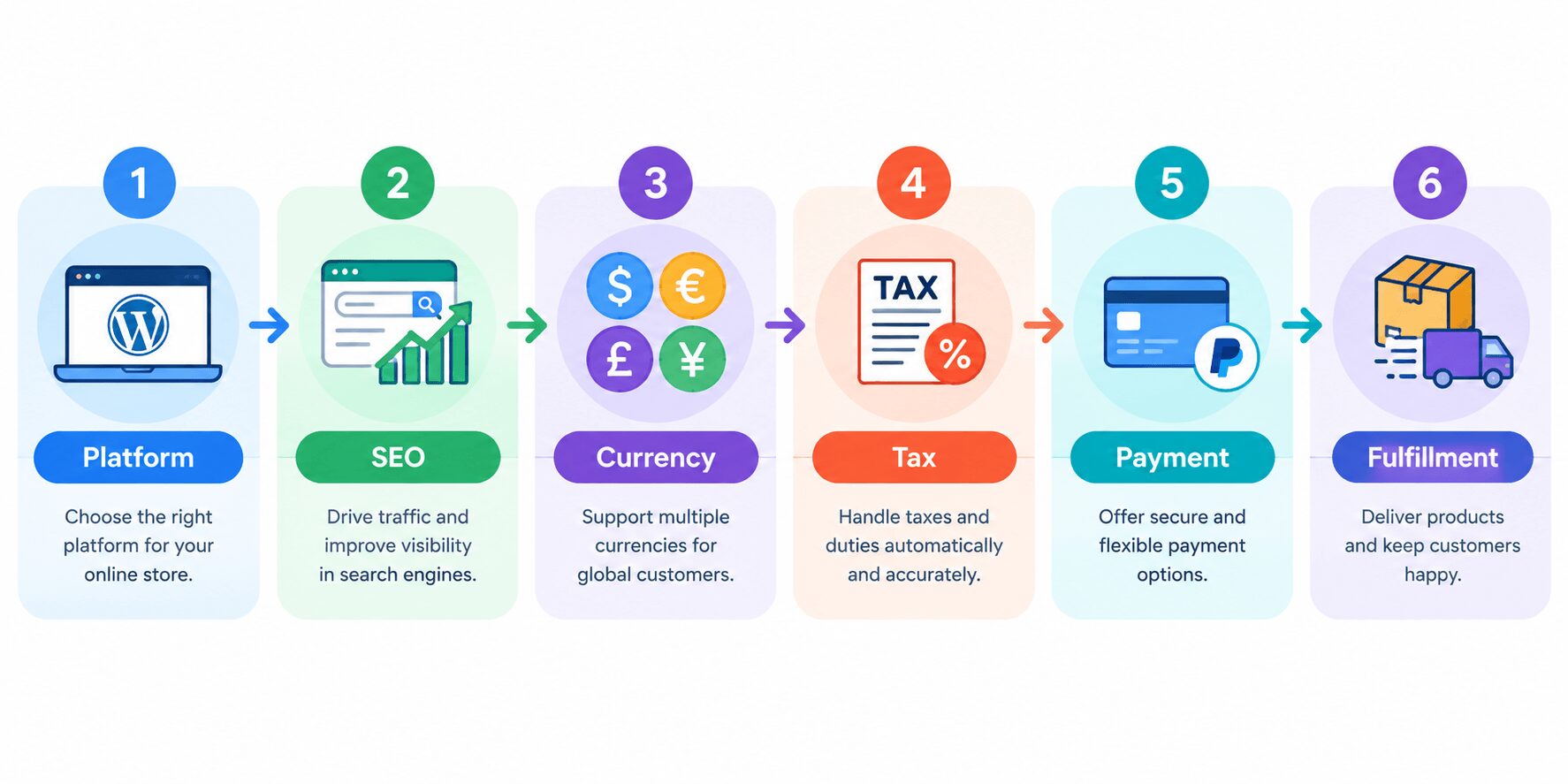
Step 1: Choose a Platform Built for Global Scale
Your technical foundation determines how much friction you fight every time you expand to a new market. A platform that requires separate plugins for currency, tax calculation, and payment routing is one that will break at inopportune moments and charge you more as you scale.
StoreEngine is built as an all-in-one WordPress ecommerce plugin — physical products, digital downloads, subscriptions, B2B pricing, and international selling all live in one system. When you expand to Germany, you don’t install a new plugin. You configure a market.
Step 2: Build Your International SEO Foundation
Before investing in international paid traffic, build organic discoverability in your target markets. This means implementing hreflang tags correctly, creating market-specific product and category content, and getting your technical SEO foundations right. The eCommerce SEO for WordPress playbook is the most practical starting point for WordPress stores targeting multiple markets.
Step 3: Configure Multi-Currency Pricing
- Enable geo-based currency detection
- Set rounding rules per currency (€9.99 not €9.87)
- Choose between display-only conversion and true multi-currency checkout
- Set up tax-inclusive pricing for EU and UK markets
- Test the checkout experience in at least 3 target currencies before launch
Step 4: Register for Tax and Set Up Compliance
- Identify which markets require VAT/GST registration based on your sales volume
- Register for IOSS if selling goods under €150 to EU customers
- Connect a tax automation tool — TaxJar, Avalara, or StoreEngine’s built-in tax engine
- Configure your store to display prices with tax included in markets that require it
- Set up a system for filing returns in each registered jurisdiction — quarterly at minimum
Step 5: Integrate Local Payment Gateways
- Start with Stripe + PayPal as your baseline — they cover roughly 80% of global transaction volume
- Add 1–2 regional gateways for each of your top 3 target markets
- Test payment flows as a customer from each market before launching
- Ensure your checkout dynamically surfaces the right payment options based on customer location
Step 6: Solve Inventory, Fulfillment, and Returns
International selling introduces inventory complexity that domestic operations don’t have. Stock running out in one market while sitting idle in another erodes margins. StoreEngine’s eCommerce inventory management auto-tracks stock across your entire store and flags reorder points before you hit a problem. When you’re restocking from suppliers, the suppliers and purchase orders system eliminates the guesswork from international restocking.
On the returns side: international customers expect a clear return process upfront — and complex or opaque return policies are one of the top reasons international buyers don’t complete their first purchase. StoreEngine’s returns and RMA management gives you a structured, automated returns flow that builds trust with first-time international buyers.
The Biggest Cross-Border eCommerce Challenges — And How to Beat Them
In 2026, tariff policies across major markets are changing with little warning. Compliance requirements are tightening. And customer expectations for delivery speed have been set by Prime and equivalent services globally — what felt like a premium two-day promise a few years ago is now table stakes.
Cart Abandonment Is Higher Internationally — Here’s Why
International buyers abandon carts at higher rates than domestic buyers. The reasons are specific and fixable:
- Unexpected duties or taxes appearing at checkout (always show totals upfront)
- Unfamiliar payment methods (localize your checkout)
- Uncertainty about delivery timelines and costs
- Currency confusion (display local currency from the first product view)
- Complex or unclear return policies
Understanding the full picture of why customers abandon carts is essential before you spend on international traffic. Fix the leaks first. Then for the customers who do leave before completing — abandoned cart recovery for WordPress can recover a significant percentage automatically through email sequences triggered by the abandonment.
Cross-Border Challenges at a Glance
|
Challenge |
Practical Solution |
|
Customs delays |
Use correct HS codes; offer DDP (Delivered Duty Paid) shipping |
|
Unexpected tax charges |
Collect all taxes at checkout; use IOSS for EU |
|
Currency volatility |
Periodic FX rate locking; multi-currency settlement accounts |
|
Fraud and chargebacks |
Enable 3DS authentication; implement AVS and CVV checking |
|
International returns |
Clear upfront policy; RMA system for structured processing |
|
High cart abandonment |
Localize currency, payment methods, and checkout flow |
|
Inventory stockouts |
Real-time inventory tracking with reorder alerts |
Growing Revenue Once You’re Selling Globally
Getting operational in international markets is step one. Growing revenue within those markets is where the real leverage is. Here’s where most international ecommerce businesses leave money on the table.
Build a Global Sales Funnel
A well-structured sales funnel converts visitors into buyers whether they’re in Toronto or Tokyo — the mechanics are the same, only the language and payment method change. StoreEngine’s guide on how to build a sales funnel in WordPress walks through the full architecture, from awareness-stage content to post-purchase automation.
Increase Average Order Value on Every Transaction
Once a customer is at checkout, there’s a clean opportunity to increase the value of that order without any additional acquisition cost. Order bumps, upsells, and cross-sells are built into StoreEngine — no separate plugin, no compatibility issues, no extra monthly fee. These work equally well for domestic and international buyers and are one of the fastest ways to improve revenue per customer.
Expand With B2B and Wholesale Pricing
Some of the largest cross-border ecommerce opportunities aren’t B2C at all — they’re wholesale relationships with distributors and retailers in your target markets. StoreEngine’s wholesale and B2B pricing lets you set tiered pricing for business buyers, approve wholesale accounts, and manage minimum order quantities — all within the same store that handles your retail customers.
Use Affiliate Marketing to Enter New Markets
Paid advertising in a new international market is expensive and slow to optimize. Affiliates — people already embedded in that market with existing audiences — are a dramatically faster path to revenue. Setting up an affiliate program for WordPress through StoreEngine lets you recruit local affiliates, set commission structures, and track payouts without a separate platform.
Why StoreEngine Is Built for Cross-Border eCommerce
The honest assessment of most WordPress international selling setups: they’re fragile. WooCommerce core, a currency plugin that breaks on major updates, a tax extension that costs $149/year, a payment gateway add-on for each market you enter. It works until it doesn’t — usually right when you’re processing high volumes from a new market launch.
The WooCommerce vs StoreEngine cost comparison makes the operational and financial case clearly. But the more important point is architectural: StoreEngine was built as a complete ecommerce system, not assembled from parts.
What StoreEngine gives you in one plugin:
- Multi-currency display and checkout — built in, no extension required
- International tax engine (VAT, GST, region-based rules) — built in
- Stripe, PayPal, and regional gateway integrations — built in
- Physical products, digital downloads, and subscriptions — all product types supported
- B2B wholesale pricing and account management — built in
- Inventory tracking with supplier and purchase order management — built in
- Abandoned cart recovery — built in
- Returns and RMA management — built in
- Sales funnels, order bumps, and upsells — built in
No transaction fees. No SaaS lock-in. No per-plugin subscription stacking. And because StoreEngine is part of the Kodezen ecosystem, it works cleanly alongside Academy LMS, ZenCommunity, and the rest of your digital product stack.
If you’re currently on WooCommerce and considering switching, the migration guide covers the full process without data loss or SEO disruption.
Conclusion: Cross-Border eCommerce Is a System, Not a Shortcut
The sellers struggling with international expansion aren’t struggling because global ecommerce is too hard. They’re struggling because they tried to layer international capability onto a store that was only built for domestic selling.
Tax compliance, multi-currency pricing, local payment gateways, inventory management, returns handling, and SEO — these aren’t separate problems. They’re one interconnected system. And when that system works, selling to customers in Berlin or Bangkok feels as operationally smooth as selling locally.
StoreEngine is that system — built into WordPress, without the plugin stack, without the transaction fees, and without the monthly subscription stacking that makes WooCommerce setups so expensive to maintain.
Build it right once. Sell everywhere.
Start your international store with StoreEngine →
Note: This data is from 2026 or earlier, so it may not match current features.
FAQs: Cross-Border eCommerce
What is cross-border ecommerce?
Selling products or services online to customers in other countries — operating across different tax systems, currencies, regulatory environments, and payment infrastructure simultaneously.
Do I need to collect VAT for international customers?
It depends on the market. For the EU, once cross-border B2C sales exceed €10,000, you must collect VAT at the customer’s local rate via OSS. For imports under €150, use IOSS. The UK requires VAT from your first sale with no threshold for overseas sellers. US rules vary by state.
What is the best payment gateway for cross-border ecommerce?
Stripe and PayPal provide the broadest global coverage as a baseline. For European markets: add Klarna, iDEAL, or SEPA. For Brazil: Pix. For India: UPI. The right choice depends on which markets you’re prioritizing. StoreEngine integrates all major gateways without additional extensions.
Can I sell internationally on WordPress without WooCommerce?
Yes. StoreEngine gives WordPress full international ecommerce capability — multi-currency, tax compliance, local payment gateways, and global fulfillment support — in one plugin, without WooCommerce.
What happened to the US de minimis exemption?
As of August 2025, goods under $800 shipped from China and Hong Kong no longer enter the US duty-free. Section 301 tariffs apply, plus per-parcel handling fees of $80–$200. Sellers using China-based direct-to-consumer fulfillment need to reassess their supply chain routing.
How do I handle international returns?
Set a clear international return policy upfront and display it prominently before checkout. Use a structured RMA system to process returns without manual back-and-forth. Consider local return hubs in high-volume markets to reduce return shipping costs.