

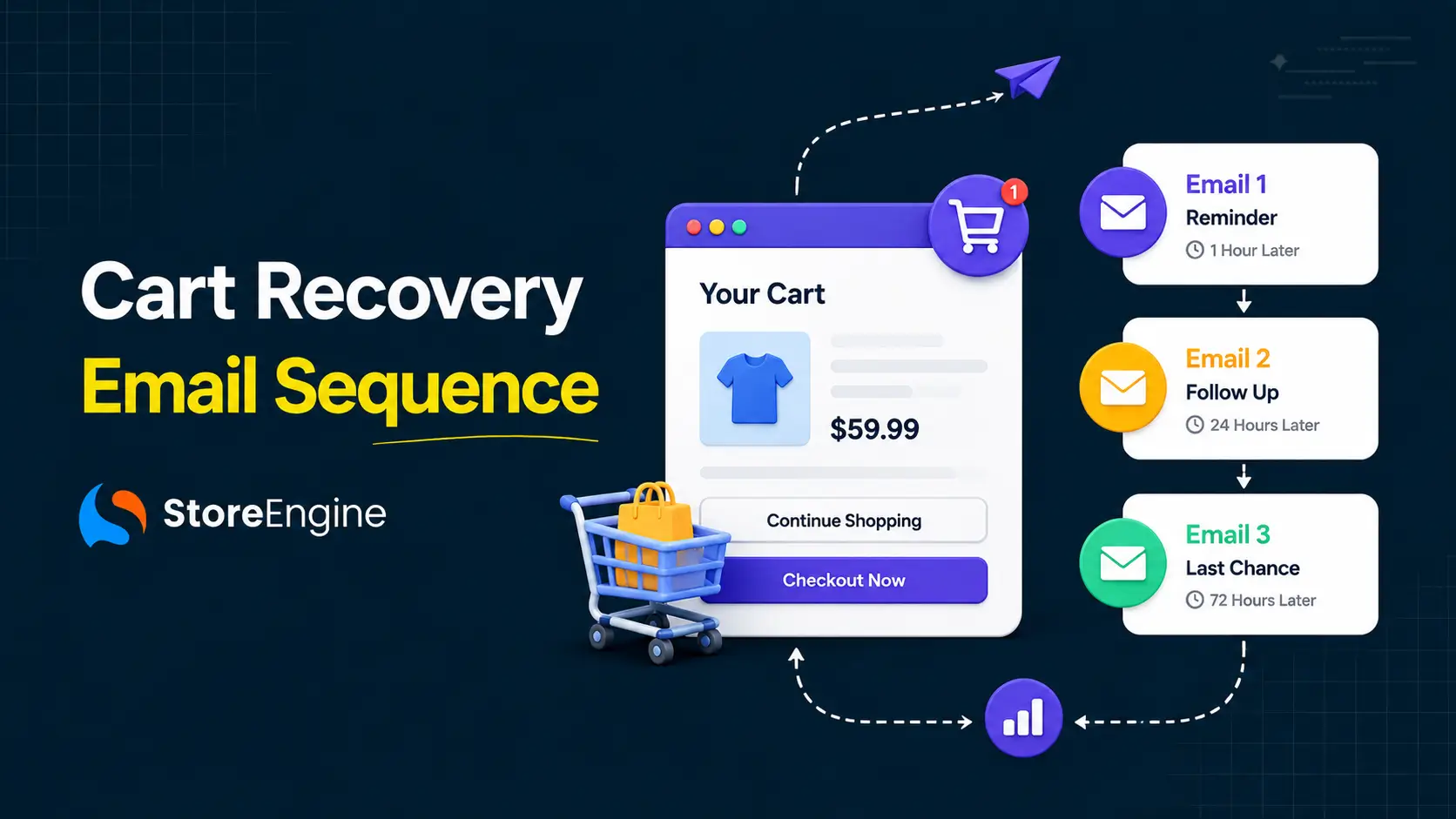

Somewhere between “Add to Cart” and “Buy Now,” roughly 7 out of 10 shoppers vanish. Not because your product is bad. Not because your price is wrong. They just… leave.
That’s not a guess. Baymard Institute’s meta-analysis of 50+ studies puts the global cart abandonment rate at 70.22% in 2026. On mobile, it climbs even higher — some datasets show mobile abandonment topping 85%, compared to roughly 67-73% on desktop.
Here’s the part that should get your attention: most of that “lost” revenue isn’t actually lost. It’s sitting in an inbox, waiting for the right email.
A well-built cart recovery email sequence is still the single highest-converting automated flow in ecommerce. Klaviyo’s benchmark data shows abandoned cart emails pulling a 3.33% conversion rate and $3.65 in revenue per recipient — and the top 10% of performers hit conversion rates above 7.69%, more than double the average.
This guide walks through exactly how to build one that works, with real timing data, subject line formulas, and the automation stack (including StoreEngine) that takes this off your plate entirely.
What Is a Cart Recovery Email Sequence?
A cart recovery email sequence — also called an abandoned cart email flow — is a series of automated emails triggered when a shopper adds items to their cart but leaves before completing checkout.
Instead of one generic reminder, a proper sequence sends 2-4 emails over 24-72 hours, each with a different job: remind, reassure, and (eventually) push with urgency or an incentive.
The reason sequences beat single emails isn’t complicated. People get distracted. A kid interrupts them, a Slack message pulls them away, their card isn’t in reach. One email might land at the wrong moment. Three emails, spaced correctly, cover more of those moments. Klaviyo’s flow data backs this up hard: three-email sequences generated $24.9 million in revenue compared to just $3.8 million from single-email flows in the same analysis — a 6.5x difference.
Why Cart Recovery Emails Matter More in 2026
Three things changed the math this year.
First, abandonment isn’t going away. Mobile shopping keeps growing, and mobile abandonment rates are structurally higher than desktop. The 70% baseline isn’t a temporary glitch to “fix” — it’s the environment you’re operating in.
Second, AI-personalized recovery emails now convert at roughly double the rate of generic templates. Recent data from Digital Applied shows AI-driven recovery emails hitting an 8.17% conversion rate versus 4.1% for standard templates — and that gap has doubled since 2024. Shoppers can tell the difference between “here’s a coupon” and an email that actually references what they left behind.
Third, deliverability got harder. Gmail’s inbox placement rates for marketing email dropped in recent quarters, which means a sloppy, spammy-looking recovery email is more likely to land in Promotions or Spam than it was two years ago. Subject lines and sending reputation now matter as much as the offer itself.
Translation: doing cart recovery “okay” isn’t enough anymore. The stores winning this in 2026 are running structured, well-timed, personalized sequences — not a single “Did you forget something?” email.
How Does a Cart Recovery Email Sequence Work?
At a technical level, it’s simple:
- A shopper adds a product to their cart and enters an identifiable state — usually by starting checkout or being a logged-in/known email subscriber.
- They leave without completing the purchase.
- A trigger (usually a timer, sometimes a page-exit signal) fires.
- Your email platform or plugin sends a pre-built email referencing the exact items left behind.
- If they still don’t convert, a second and third email fire on a delay, each with an escalating message.
The mechanics matter less than the sequencing logic behind them. Here’s the timing structure that performs best based on current benchmark data:
|
|
Timing |
Goal |
Tone |
|
Email 1 |
1 hour after abandonment |
Reminder |
Helpful, no pressure |
|
Email 2 |
24 hours after abandonment |
Reassurance / objection handling |
Address hesitation (shipping cost, trust, sizing) |
|
Email 3 |
48-72 hours after abandonment |
Urgency / incentive |
Discount, stock scarcity, or deadline |

Some advanced setups now layer in push notifications and SMS ahead of email (a 15-minute push, a 1-hour email, a 24-hour SMS), but email remains the backbone because it’s cheap, automatable, and doesn’t require opt-in friction the way SMS does.
Benefits of a Cart Recovery Email Sequence
Based on 2026 benchmark data across major platforms, here’s what a properly built sequence actually delivers:
- Recovers 15-30% of abandoned carts that would otherwise be gone for good
- Generates $3.65+ revenue per recipient on average, with top performers well above $28
- Costs almost nothing to run once set up — it’s automated, not a manual task
- Builds trust by reminding shoppers you noticed and care, not just chasing a sale
- Surfaces objections you didn’t know existed — if your second email addressing shipping costs converts well, that’s a signal your checkout has a pricing transparency problem worth fixing at the source
Stores with a mature abandoned cart strategy — sequences, retargeting, and checkout optimization working together — generate roughly 12% more overall revenue than stores without one, according to Klaviyo’s merchant benchmarking.
What Should Be Included in a Cart Recovery Email?
Every email in your sequence should hit these basics, but each one earns its place differently:
Email 1 — The Reminder
- Product image, name, and price of exactly what they left behind
- A single, obvious “Complete Your Order” button
- No discount yet — you don’t want to train customers to always wait for one
Email 2 — The Reassurance
- Answer the objection that’s most likely stopping them: shipping cost, return policy, product questions
- Social proof — a review or two for the specific product
- Optional: live chat or support link for hesitant buyers
Email 3 — The Nudge
- A time-limited incentive (discount, free shipping, or a bonus)
- Genuine scarcity if it’s real (“Only 3 left in stock”) — never fake it, customers notice
- Clear deadline for the offer
Keep every email short. Nobody reads a 400-word essay about a T-shirt they almost bought.
Best Cart Recovery Email Subject Lines That Convert
Subject lines carry more weight than most merchants think — the first email in a sequence already opens at a strong 60%+ rate because intent is high, but weak subject lines still cost real recovery revenue. Formulas that consistently perform:
- “You left something behind, [First Name]”
- “Still thinking it over? Your cart’s waiting”
- “[Product Name] is still in your cart”
- “Your cart expires soon — here’s 10% off”
- “Quick question about your order”
Avoid ALL CAPS, excessive emoji, and anything that reads as clickbait — spam filters and shoppers both punish it.
Real-World Examples of Cart Recovery Email Sequences

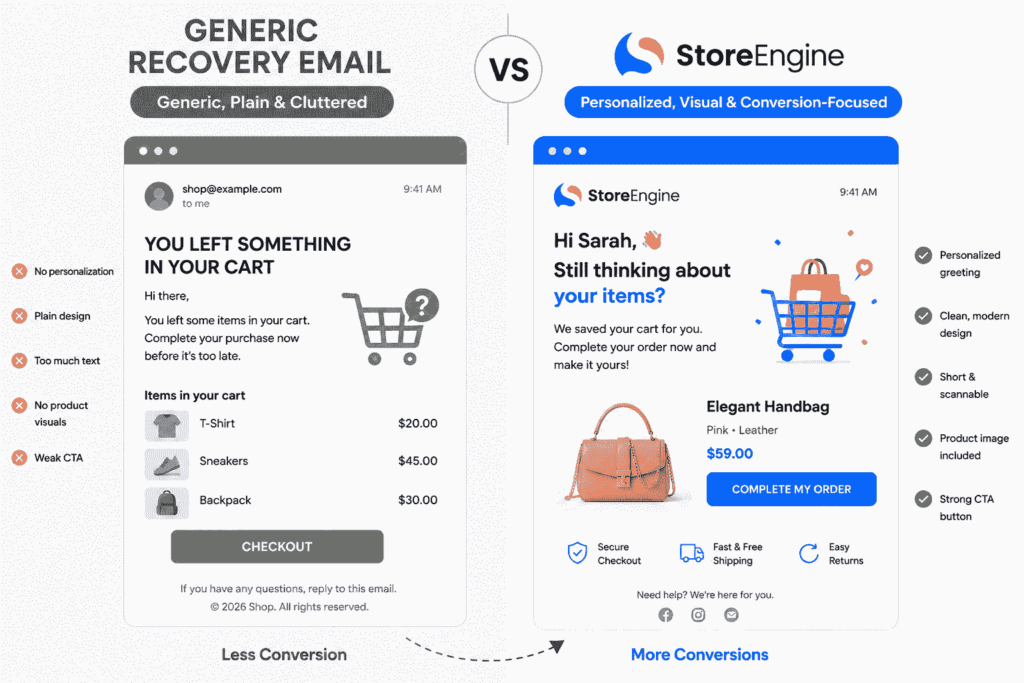
Example: A WooCommerce apparel store Email 1 sent at the 1-hour mark shows the exact product photo with a “Still want this?” headline. Email 2, sent the next day, includes three customer reviews for that specific item. Email 3, sent 60 hours later, offers free shipping if the order completes within 12 hours.
Example: A subscription box brand Email 1 focuses on what the shopper is missing (this month’s curated items). Email 2 handles the most common hesitation — cancellation flexibility. Email 3 offers a bonus item instead of a discount, protecting margin while still creating urgency.
Neither example relies purely on discounting. That’s the pattern among stores that recover carts without eroding margin — reassurance and product-specific relevance do more work than most merchants expect.
Tools Used in Cart Recovery Email Sequences
Most stores use one of two approaches:
- Standalone email platforms (Klaviyo, Mailchimp, ActiveCampaign) connected to your store via integration — powerful, but often expensive at scale and requires stitching multiple tools together.
- Native ecommerce plugins built for WordPress/WooCommerce stores that handle cart recovery inside your existing store stack, without a separate subscription or complex integration.
This is where StoreEngine fits in. It’s built specifically for WordPress store owners who want cart recovery, checkout optimization, and store management working together instead of duct-taped across five different tools.
StoreEngine handles the recovery sequence natively — timed, automated emails that trigger the moment a cart is abandoned — while also giving you the infrastructure that reduces abandonment in the first place: a fast, low-friction checkout, transparent pricing at the cart stage, and flexible payment options. Since unexpected costs cause roughly half of all abandonments, fixing that at checkout does more than any single recovery email ever could.
StoreEngine also ships with features most recovery-focused plugins don’t touch, which matter once you’re running a real store rather than a single product page:
- Multi-Location Inventory — track stock across warehouses or physical locations, so recovery emails never promote something you can’t actually fulfill
- Cost & Profit Tracking — see real margin per order, so recovery discounts don’t quietly wreck profitability
- POS Terminal — unify online and in-person sales under one system
- Suppliers & Purchase Orders — keep restocking in sync with demand your recovery emails are generating
- Return / RMA System — structured handling for the returns that inevitably follow a recovery-driven sale
- Couriers Management — centralized shipping and fulfillment tracking
You can see the full breakdown on the StoreEngine features page or check it out directly on WordPress.org.
Cart Recovery Email Sequence vs. Other Recovery Methods
|
Method |
Cost |
Recovery Rate |
Setup Effort |
Best For |
|
Email sequence |
Low |
15-30% of abandoned carts |
Low-Medium (once automated) |
Every store, as a baseline |
|
SMS recovery |
Medium (per-message cost) |
Higher urgency, lower reach |
Medium (requires opt-in) |
High-AOV or time-sensitive offers |
|
Retargeting ads |
Medium-High |
Varies widely |
Medium |
Broader brand recall, not just cart-specific |
|
Checkout optimization |
One-time dev effort |
Prevents abandonment upfront |
Medium-High |
Fixing root causes, not just symptoms |
The highest-performing stores don’t pick one. They run email as the backbone layer in checkout optimization to reduce the abandonment rate itself, and add SMS or retargeting for higher-value carts.
Future Trends: What’s Changing in 2026 and 2027
AI-personalized send timing. Instead of a fixed “1 hour, 24 hours, 72 hours” schedule, machine learning models are starting to predict the optimal send time per shopper based on their past behavior — some tools already show measurable lift from this.
Deliverability becomes a bigger battleground. As inbox placement rates tighten, expect more emphasis on sender reputation, authentication (SPF/DKIM/DMARC), and email design that avoids spam triggers.
Pre-abandonment intervention. A newer category of tools is trying to catch hesitation before the shopper leaves — behavioral signals during checkout that trigger an on-page nudge instead of waiting for a post-abandonment email. Recovery emails aren’t going away, but they’re increasingly paired with earlier intervention.
Channel blending. Push notification, email, and SMS working as one coordinated sequence rather than separate campaigns is becoming the standard for higher-AOV stores.
None of this replaces the core sequence — it just makes it sharper.
What is the ideal abandoned cart email flow for ecommerce? A three-email flow paired with checkout-level fixes (transparent pricing, guest checkout, fewer form fields) — recovery emails work best when they’re not compensating for an avoidably leaky checkout.
The Bottom Line
A cart recovery email sequence isn’t a nice-to-have anymore — it’s one of the few marketing channels where the ROI is proven, repeatedly, across every major platform’s benchmark data. Three emails, the right timing, and messaging that actually addresses why someone left will recover revenue that’s already technically yours.
If you’re running a WordPress store and don’t want to stitch together five tools to make this work, StoreEngine builds cart recovery directly into your store’s foundation — alongside the inventory, profit tracking, and fulfillment tools that keep the recovered sales actually profitable.
FAQs
What is a cart recovery email sequence?
It’s a series of automated emails — typically 2-4 — sent to shoppers who added items to their cart but didn’t complete checkout, designed to bring them back and finish the purchase.
How many emails should be in a cart recovery sequence?
Three is the sweet spot for most stores. Klaviyo’s data shows three-email sequences dramatically outperforming single-email flows, while going beyond four emails tends to show diminishing returns and higher unsubscribe risk.
What is the best timing for abandoned cart emails?
Roughly 1 hour, 24 hours, and 48-72 hours after abandonment. The first email should go out fast, while intent is still high.
How does a cart recovery email sequence work?
A trigger (usually cart abandonment or checkout exit) starts an automated timer. Each email in the sequence fires on a delay, referencing the specific items left behind, with escalating messaging across the sequence.
Do cart recovery emails really increase sales?
Yes. Industry benchmarks consistently show 15-30% cart recovery rates from email alone, with average revenue of $3.65+ per recipient and top performers well beyond that.
What should be included in a cart recovery email?
The exact product(s) left in the cart, a clear call-to-action, and — depending on the email’s position in the sequence — reassurance, social proof, or a time-limited incentive.
What are the best cart recovery email subject lines?
Direct, personal, low-hype lines outperform aggressive sales language. “You left something behind” beats “DON’T MISS OUT!!!” almost every time.
How to create a high-converting cart recovery email sequence?
Start with three emails on the 1-hour / 24-hour / 72-hour timing model, keep the first email discount-free, address objections in the second, and reserve urgency or incentives for the third.
How to automate abandoned cart email sequences?
Use a plugin or platform that triggers automatically on cart abandonment — for WordPress/WooCommerce stores, a native tool like StoreEngine handles this without needing a separate email platform subscription.
What is the ideal abandoned cart email flow for ecommerce?
A three-email flow paired with checkout-level fixes (transparent pricing, guest checkout, fewer form fields) — recovery emails work best when they’re not compensating for an avoidably leaky checkout.